New Submission Grinder Feature: Market Story Links!

Hello! I am here with Erin Cairns (of InkFoundry) to announce a new Submission Grinder feature in collaboration between the two sites!

(Erin here! Hi!)

What is the Submission Grinder?

The Submission Grinder is the sister site of Diabolical Plots and run by the same publisher. It is a donation-supported online tool to help writers track submissions, find publications for their work, keep track of payments, and more.

What is InkFoundry?

In Erin’s words:

InkFoundry is a story-discovery tool, made to help readers find interesting, engaging stories tagged with every niche interest under the sun! Inspired by the accessibility and discoverability of Archive of Our Own, InkFoundry archives links to professionally curated, well-edited, artist-paid, free-to-read stories from online magazines and journals.

What are Market Story Links?

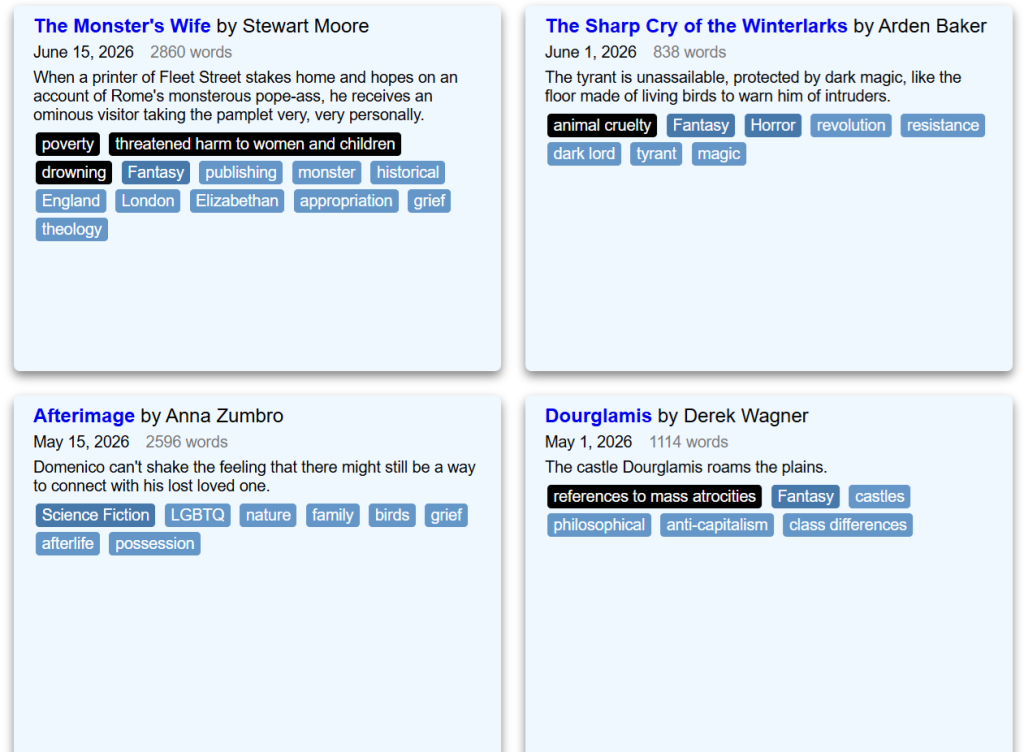
Market story links are links to free-to-read stories published by a publication that has a Submission Grinder market page. You can see them in action on the Diabolical Plots market listing, where it shows a link to the most recently published story as well as a link to a random story from the backlog of published stories.

Besides those couple of links on the market page, it also has a link to the stories page for the publication where readers can find a list of all of the stories that have been uploaded for that publication.

Modern audiences are familiar with tags and using them, and these cards are a very quick and easy way for them to recommend stories to each other– with warnings, tags, and a tantalizing hook.

What is the Collaboration?

Publications that meet certain criteria can name a user account as a trusted representative, and then that representative can upload spreadsheets of story promo data. And then that story promo data will also be shared automatically with InkFoundry and if it meets their criteria (i.e. for InkFoundry it has to be speculative), then they will add it there as well.

For a publication to name a trusted representative, they just need to contact The Submission Grinder through our contact form and tell us that you want to name a trusted representative for your listing, and we will help you get verified and set up to do that. The trusted representative will need to register for a free Submission Grinder account (we do not share or sell your account information, and we do not send you any advertisements – we do have a couple of newsletters, but those are opt-in only).

What Criteria Does a Publication Have to Meet to Use This Feature?

  • the publication has to have a full Submission Grinder listing (not an incomplete/stub listing)
  • has to be a fiction publication (nonfiction and poetry may be added later)
  • Stories have to be linkable to read online
  • the listing must not be marked as Non-Standard Contract
  • cannot charge submission fees
  • cannot use generative AI art, or accept generative AI writing
  • has to pay writers
  • has to have an authorized representative (this can be set up by requesting it through our contact form!)

Why is the Collaboration?

If you followed the earlier link to InkFoundry, you might think that the Market Story Links in the last question looked like basically the same thing. And they are! Both sites started implementing them roughly the same time, but InkFoundry has done a great job implementing great frontend search interfaces and getting a lot of data entered. The Submission Grinder has certainly made some progress and will continue to make some progress, but InkFoundry certainly has a much more mature searching and tagging system.

Submission Grinder has done other things for this very well, particularly a bulk upload tool that takes a spreadsheet file containing story promo metadata, and can upload a lot of records all at once. Allowing it to be put in a spreadsheet makes it much easier to fill it in and format it using programs, or by crowdsourcing story tagging to a publication staff or even a fanbase.

Erin and I realized that this was a great opportunity. The Submission Grinder has a robust spreadsheet import that makes it easy for a publication to add a whole backlog efficiently. InkFoundry has a solid search functionality and has a reader-based mission statement instead of a writer-based mission statement which is ideal for the goal here. By sharing the story promo data, it encourages publications to use the Submission Grinder interface to allow them to benefit from that.

Readers are ready! Help them find you and stories they can click on with enthusiasm! Inform them about what they’re about to read with tags and pitches, hooking them just a little bit at a time until they’ve got a hundred open tabs of stories they can read over breakfast or on their lunch break or in line at the grocery store!

Conclusion

If you have any questions please reach out to either of us!

DP FICTION #137A: “The Last Optician” by Ann Calandro

edited by Amanda Helms

He’s the last independent optician working in my zone. Two or three years ago, there was a second one, but she worked part time and by appointment only. Who could make appointments for the future even then? The last optician doesn’t require appointments. People can stop by any weekday during normal business hours to order new glasses or to get their eyeglasses frames tightened and adjusted. It’s just him, a pale, middle-aged guy with receding wispy hair—no receptionist, no assistant, no partner eye doctor, no brochures, no music, no free cleaning solution or microfiber cloths, not even a real waiting room area. He does have his license framed and hanging on the wall, even though opticians are no longer required to be licensed. It’s crooked. I always have to resist the urge to straighten it.

The last optician is located in a decaying strip mall, in a long, narrow room with a utility table and several plastic chairs. The room needs painting. There’s still a luncheonette in the strip mall, but the other stores have closed. Against one wall are shelves holding optical tools, a lens grinding machine, and parts of frames, their earpieces mingling in pleasing bursts of color. Sometimes he’s attending to other customers, but mostly he’s alone, looking at his phone, grinding lenses, or examining a pair of frames.

By now, lots of people have undergone LASIK or cataract surgery. Some people are born with good vision, and others can wear contacts or the stylish boxy glasses where the nosepieces don’t need frequent adjustment. Because so many people use self-driving cars and voice dictation, no one seems to need to see things as clearly. Maybe people don’t want to see things clearly. Now that people are required to stay in their zones unless they obtain a “purposeful travel pass” to another zone, most people who need eyeglasses just order them online or go to the multiple glossy boutique optical chains in every zone. The Conglomerate owns the boutiques. I went to one once, right after the Conglomerate seized power from the enfeebled government but before everyone needed “purposeful travel passes” to travel between zones. The passes were devised because the Conglomerate wants to know that people are either at work or spending money, not taking a walk with no particular destination or sitting in a park, reading or resting. Of course, now there are no public spaces in which to sit or walk, but until a few years ago, there were still a few.

In the boutique I went to, the music was very loud. It was hard to concentrate. I was told that there was no frame that would work with my prescription and that the only brand of lenses the boutique carried was not the brand I wanted.

“The Conglomerate says the lenses and frames you want are cost-prohibitive,” the young optician whispered, leaning close and pretending to position my glasses on my nose. “We’d have to charge more than people would pay to still make our target profit. Besides, most people adjust well enough to the brand we carry. But sometimes people like you still ask for the better brand.”

“Like me how?”

“High myopia and moderate astigmatism, or very far-sighted, or people needing a prism in the lens. Just about anything that doesn’t fit into the Conglomerate’s cost-benefit ratio algorithm. I’m sorry. Like everyone, I’m a hostage to the Conglomerate structure and its dictates, or I’ll lose my job.”

“What do you tell other customers like me?”

“What I’m telling you now: Find an independent optician before they all go out of business, and buy as many pairs of glasses you can afford, while you still can. If you have insurance, use it. I’ve heard rumors that the copays and exclusions and deductibles are only going to get worse.”

That’s what I did. I found the last optician, who at the time was the second-to-last optician in what became my zone, and I ordered multiple pairs of eyeglasses from him, using all my remaining insurance before I retired and also paying out of pocket for what insurance didn’t cover. When you need specific glasses to see, there’s no internal debate about spending money.

It’s raining hard when I run from the parking lot and push open the door to the last optician.

“Hello once again,” I say, sitting down in one of the plastic chairs. I’m glad they’re plastic because my jacket and jeans are soaked. I put a couple of dollar bills in the donation can and a chocolate bar on the table. Adjustments are always free, but I feel bad about coming in for adjustments so frequently and not needing to buy new glasses.

“I think the left lens is out of whack. I bumped into the corner of my refrigerator.”

“Let me see,” he says, holding out his hand. I give him my glasses.

“This is such a good frame,” he says, looking at them. “Made in Austria. Good engineering. No screws at all. They’ve lasted well all these years.”

“I know,” I say. “You recommended them. Remember when I first came here, about ten years ago? I’m careful with this pair, and I have duplicates at home.”

“That’s good, because we can’t import these frames anymore. I don’t know if your lenses are sold outside of Europe anymore either.” The optician goes over to the shelves, picks up a tool, and adjusts my frames.

“Here, try them on,” he says. “They should be fine now.” I put them on and focus on the middle distance. I can see clearly again.

“Perfect,” I say. “Thank you. I’ll come back when they’re out of whack again. You’re not planning to close up shop and retire, are you?”

“Not yet,” he says. “In a couple of years, maybe. Once my daughter finishes college. The Conglomerate keeps raising the interest rates on her loans and my rent on this place. I don’t have the customer base anymore to be viable long term. Many people can get by at the boutiques, or they just order online.”

“Anything new in the world of lenses?” I ask. I like hearing about new optical developments.

“Not really anymore,” he says. “It’s all just marketing now. There’s nothing new that’s an improvement over the lenses you have, so I don’t recommend you get new glasses unless you need a new prescription.”

“I don’t need a new prescription,” I say. “Hopefully I never will, unless it is because of cataract surgery someday.”

“I don’t know whom you’ll find to do the surgery,” he replies. “Everyone I used to recommend or know has retired. They didn’t want to work for the big chains the Conglomerate owns and do fifty or a hundred procedures a day. What kind of way is that to do surgery on the eyes?”

“I know,” I say. We sit in silence for a few minutes.

“You want to run out for a minute and get a coffee or a muffin from the luncheonette?” I ask. “I’ll stay here and tell anyone who comes in that you’ll be right back.”

“No, I’m good. But thank you. The luncheonette is closing at the end of the month anyway. The owner’s joining one of the big restaurant chains as a line cook. I bring my own lunch now.” He gestures to a thermos and a brown paper bag on one of the shelves. “Thanks for the chocolate.”

“You’re welcome,” I say. “Thank you for adjusting my glasses. Take care.”

He raises his hand in a wave, and I wave back. I go out to the potholed parking lot, the paint between parking spaces long faded, and get into my car. It’s still raining. The weather is strange now. It veers from suffocatingly hot to dangerously cold. Heat and power and phone service are more unpredictable than ever, and it’s impossible to get through to any customer service options except the voicebots, who pretend not to understand or really don’t understand. Besides my car and the optician’s car, there’s one other car in the lot, near the luncheonette. It’s probably the owner’s car. Nobody’s going to be out on a day like this unless they have to be. I start my car and turn on the defroster. My car is so old that it could be designated a classic, but then I wouldn’t be able to drive it anymore, and there’s no longer any public transportation except in a few big cities. New cars cost upwards of $100,000 now, and the used car market is unregulated.

“You’re still working,” I say to my car. “And the optician is still here. And I probably have the last car CD player and extensive CD collection for miles.” Everything in music now involves streaming through tinny earbuds. The great concert halls of old faded and crumbled away after the third pandemic and the repeated government shutdowns. I look through the pile of CDs I keep in the front passenger seat and put one in. I keep up with the new music, to the delight of my two grandsons, especially a new band called Broken Promises. Secretly, though, I prefer the music of my youth. The defroster kicks in, a counterpoint to Bob Dylan’s prophetic nasal voice. I sing along, following his advice to forget about today until tomorrow, while I watch the hard rain fall.


© 2026 by Ann Calandro

1563 words

Ann Calandro is a writer, artist, and classical piano student. She received a 2026 Finalist Award from the New Jersey Council on the Arts (prose category). Her writing has appeared in Lit Camp, The Fabulist, The Plentitudes, and other literary journals. Serving House Books published her short story collection, Lost in Words, in February 2025 and her poetry collection, To Keep You in This World, in January 2026. Her artwork has appeared in literary journals, been included in the 2023 New Jersey Arts Annual, and exhibited at Phillips Mill, the Monmouth Museum, the Biggs Museum of American Arts, and many galleries. Shanti Arts Press published three children’s books she wrote and illustrated. See artwork at ann-calandro.pixels.com


If you enjoyed the story you might also want to visit our Support Page, or read the other story offerings.
DP FICTION #136B: “The Monster’s Wife” by Stewart Moore

Content note (click for details) Threatened harm to women and children; non-graphic mentions of death by drowning; poverty

edited by Ziv Wities

The monster came out perfectly.

The head of an ass. A human left arm, delicate in comparison to the elephant’s right forefoot. A woman’s torso⁠—a whole torso, and quite naked. Provocative, but then, this was for religious purposes. An eagle’s left leg, and the right leg of a cow. Or a bull. Who but a husbandman could tell the difference? An old man’s face grimaced from where the buttocks should be, and below that a long dragon’s neck and head emitted ominous puffs of gas.

Perfect.

John Bateman, printer of Fleet Street, London, hung the folio sheet up to dry. The likeness was wonderful. As the pamphlet told, the monster had washed up dead in Rome nearly a century before, in the year of Our Lord 1496, after a flood of the River Tiber. As the great reformer Philip Melanchthon of Wittenburg had stirringly explained, it demonstrated the judgement of God Almighty against the sins of the Romish church.

Tomorrow, John and his family would fold, stitch and cut hundreds of the pamphlets. Melanchthon’s words were ripe for a new audience, and would marshal support for the defence of England against the Spanish fleet. And who could say? Perhaps they would draw the attention of Good Queen Bess herself, and a royal commission or two.

“’Tis well made, husband,” said Katie.

“Aye, ’tis well all ’round. None doth set type nicer and quicker than thou.”

“It should draw good custom.”

John considered all the hanging broadsheets. The sooty smell of drying ink filled the shop. It was a great improvement on the noisome vapours of the cesspit below the floor. The few candles that illuminated their late-night work threw flickering shadows on the paper labyrinth.

“And ’tis good service to the realm.” But yes, good custom first and foremost. And perhaps the salvation of their press. Procuring so true a facsimile of Master Cranach’s original engraving of the monster was a triumph, but an expensive one.

John and Katie surveyed the hundreds of little monsters all around them, and sighed contentedly. Their tired fingers and shoulders urged them upstairs to join their little ones, already abed.

Someone knocked on the shop door.

A gentle rap, not a pounding that would attract the attentions of a night watchman. The city was on alert for potential Spanish spies preceding the oncoming armada, and uneasy dreams thickened the air.

The tapping continued. The sound spoke as clearly as words: “I do not wish to draw undue attention, but I shall not and will not leave until my suit is known. Dare me not to knock louder.”

John pushed his heart back down into his chest, and with slow breaths ducked under the inky pages. He lifted the bar and creaked the door open an arrow-slit.

The fog-shrouded moon above gave only faerie-light to the street, but it was enough to see the figure towering above him, cloaked from head to toe. John’s mother had told him tales of monks in Bloody Mary’s reign, and in his dreams they looked much like this.

“Good even, Goodman Bateman,” the monk said. His voice was deep and, strange to say, came not from the head but the midsection. The accent was foreign; Romish perhaps?

“The hour is very late for strangers,” John snapped, allowing himself as much rudeness as he dared. After all, it was quite possible this was an agent of the Queen.

“Nay, Goodman Bateman. Thou knowest me.” He leaned forward, yet nothing but darkness appeared under the cloak. Again the voice came from below and behind: “Or rather, thou knowest my kind.”

Was the stranger threatening them? “We are not papists, nor hiders of papists, if you mean that.”

“Nay. Not precisely.” The man’s voice rose slightly, threatening a shout.

Katie appeared at John’s shoulder, Gripping his arm tightly, she drew him back, and said, “Do come in, good sir.”

John and Katie turned along the wall, the only way provided by their hanging sheets. The huge monk ducked low to pass under their doorway, and followed them. The high ceiling of the shop permitted him to stand at full height. Katie led them to a pair of typesetting tables set facing each other, each with a high seat. “Will you sit?” Katie asked.

“I shall, gladly. It has been a tiresome journey.”

John gestured toward the seat nearest the monk. As in a warped mirror, they sat at the same time. Katie drew up a third stool for herself. The upright typesetting rack would have blocked their view of a shorter guest.

John put a hand to his head. “What do you want of us?” he whispered.

“To ask a favour.”

The shadow under the cowl turned this way and that, absorbing the printed monster many times over. It expelled a shuddering breath.

“Thinkst thou this poor departed creature has aught to do with thy human squabbles? I implore thee as being, I hope, a man not without feeling, that thou wilt destroy these unauthorised images.”

“Unauthorised!” squawked John. “I paid right handsomely for these!”

“But didst thou think to ask her kin?” the monk hissed.

“I see not what business it is of theirs,” huffed John. “A monstrous birth is God’s will, God’s lesson, and God’s property, not some peasant brood’s.”

Katie reached out her ink-stained hand. “Are you of her family then?”

“Aye. I am that. So I ask again, John Bateman, that thou destroy these slanderous copies, and leave us out of thy petty affairs.”

That would ruin them. Did this man have no notion of what he asked, or did he not care? John’s pride in their work and livelihood shook the weights from his tongue. “Is it a petty affair, sirrah, to restore the ancient gospel from popish superstition? ’Tis well known this beast, washed up on a Tiber flood, is a judgement on Rome and its corruption! ’Tis proved by Doctor Melanchthon, in the text now translated by mine own wife. Herein he shows how each monstrous appendage represents the very sins of the pope. The ass’s head bespeaks the stupidity of⁠—–”

Without a word, a delicate hand reached out of the sleeve and flipped back the hood of the cloak. An ass’s head stared down at them, joined in silent chorus by five hundred reproductions all around. John thought all asses had a melancholy look in their eyes, but this visage reflected a sorrow much deeper than that. In awe, he turned to Katie. A tear coursed down her cheek.

“True,” he whispered. “’Tis true. I knew ’twas true.”

“Yes,” she said. “Yes.”

They’d never said it to each other. They never had to. They knew how likely it was that the whole story was a lie. Lies flew thick and fast these days, and not all of them were Catholic ones. It was one thing to gamble all on the truth, but when you could not even be sure of that… To be nothing more than another cheap purveyor of lies⁠—that was horrible to suppose. Yet the empty stomachs of their little ones were worse to think on.

But it was all true. And John and Katie felt no horror in the monster’s presence, but joy.

“She was your wife,” said Katie.

“She was,” it said.

Katie leaned forward. “Sir, what is your name?”

“I will not give it thee. The sounds of our speech are not such as thine. As like as not, it would only amuse thee. And I am in deadly earnest. I could, if I wished, burn this place to the ground.” It picked up a candle and made the slightest gesture towards the bottom edge of the nearest broadsheet.

“Please!” cried Katie. “Our pretty ones are upstairs! You’d not harm them!”

“I know who is in this house,” the monster said, but it set down the flame. “Thou shalt destroy these pamphlets.”

“I cannot,” said John.

The ass’s eyes regarded him with cold intelligence that a true animal could never muster. John ached to drive the monster out into the street and destroy it, he knew not how. It must have been twice his weight. The floorboards groaned uncomfortably when it shifted.

“I cannot,” John repeated, trying to implore without begging. “It would be the ruin of us. What I paid for that image, I can recover no way but by the sale of these.”

He rubbed his hands together and could not meet the monster’s eyes. His words were running out like hourglass sand. “And besides, would you deny an Englishman his chance to rally his nation against its foes? Under the papist hordes, surely you see that a printer of England would be driven from his livelihood, or worse?”

The monster stood, its head practically to the rafters. “My kind has seen kingdoms better than this sink into the sea. What will befall thy little island concerns me not. This… desecration of my beloved… concerns me very much.”

“Then why did you not trouble Melanchthon with these complaints? It was he who first brought out this image.”

“I knew not his plans when he made them. Since then, we have become more attentive.”

“How?” asked Katie. “How did you know to come to our door?”

The ass brayed once, and the voice chuckled. “The community of printers of Europe is a small one, and it loves rumours of forthcoming publications best of all. The engraving thou commissioned was uncommonly fine, and much remarked upon.” The ass regarded the closest of the portraits with a miserable eye. It huffed, or sighed, or both. “The Jesuits in thy land operate more than the one press recently confiscated, and they owe my kind some small favours.”

John could not contain his curiosity. “Yet how could you travel among us, such as you are? And so speedily?”

“If I tell thee, John Bateman, what wilt thou give me in return?”

“I promise… to think about it.”

Again, the soft bray and chuckle. “For such precious coin as that, I would dare much.” The hand reached up, gripped the edge of the cloak, and tore it off. It thumped to the floor in a heavy heap.

The monster stood revealed, the masculine version of his wife’s image. Yet there was more. Huge leathery wings unfurled. Many broadsheets imprinted themselves on the membranes.

“We travel much faster than ye humans, Goodman Bateman. Thy borders and kingships mean little to us. My wife’s wings were torn off in the flood that took her from me. I held on to her with my good claw, but we are delicately made.” He raised the eagle’s talon that was his left foot. “The waters were too strong, the rain too thick to fly in. I saw her eyes in that last moment, before she was taken. We spoke more love in that instant, John Bateman, than a penny-counter such as thou could match in many lives.”

His tail, swishing, spat out sparks that died, mercifully, on the floorboards. “Now. Wilt thou still measure my pain against thy fear?”

John stammered, searching for words that would lead out of this nightmare. “But see, you need not suffer from my small transgression. Tomorrow, think how many thousands of pamphlets will be for sale on Paternoster Row by the Cathedral, on every topic on which men will speak⁠—which is all of them. And that counts not the illicit trade, the products of the Catholic press lately uncovered in Oxford. Every stall sells pamphlets and broadsheets and books upon books, and who can read it all? Who can make sense of it all? Shall not my little pages sink into the ocean of print, and swim in it, and vanish, and trouble you no more?”

The monster’s face was as stony as any ass’s ever was. “And yet thou hope to sell hundreds of them? Thy self-contradiction does thee no credit. But I will make thee a bargain. Thou mayst sell thy sheets tomorrow, if thou do but cut off thy wife’s face, and nail it to thy door. Then shalt thou know how I suffer, in the presence of these.”

John looked from Katie to the monster, caught between its brutal words and the no less brutal figures in his accounting book. In his desperation, for one terrible moment, he imagined himself doing what it said. And for one terrible moment, Katie saw him thinking it. So fine was the line between life and death in London Town.

John wrung his hands. “I do not suppose… you could pay me to destroy them?”

Silence hard as flint was the only answer.

Katie stood and moved around the tables to stand beside the monster. She took up the human left hand.

“Sir,” said Katie, “so unusual a form as yours can only be due to the will of Heaven. If you and your wife be not a symbol of Romish Babylon, pray tell us, whence do you come and what judgment of God do you signify?”

“I am no symbol,” it roared, tearing its hand free. “No, nor my wife neither!” Its wings buffeted the air, causing paper to brush against paper. John winced at the waste.

Katie stood still and strong. The ass’s head chuffed, and the voice sighed. Wisps of smoke rose from the dragon-tail. The monster furled his wings and sat back down, heedless of his nudity. The chair creaked.

“A symbol. Always ye humans think in symbols. Never of what is, simple and of itself. Always need ye ask, ‘What doth it mean?’ Well, then, what dost thou mean, Goodwife Bateman? In thy standing here before me, what dost thou signify? In thy rising up and thy lying down, what dost thou mean? Tell me that, if thou canst!”

Katie gazed down at the floor. John knew the look and kept his counsel. His wife was the better printer and accountant, and he knew what it looked like when she thought deeply.

She met the monster’s gaze once more. “I would say many things. I would say that to my children, I signify the love of the Provider God. To my husband, I signify the help of the Intercessor God. To many men in England, as a woman, I signify the abnegation of the Sacrificing God. I would say these things, and then I would be nothing in myself, but only a plaything of others. There are many in this land, Anglicans and Puritans and Catholics alike, who would urge me to say such a thing of myself. Therefore I will not. I am, as I do now say you are, myself and no symbol.”

The ass clicked its teeth. “Thou seest then, if but dimly, what I suffer.”

Katie held up a hand. “But I am, then, the one who decides for myself, in the constraints I am given. And I do not decide that my family should be thrown into the street for penury, to starve until the winter, when we shall at the last freeze to death, driven onto the icy Thames. I had rather we burn tonight than that. You may join us in the conflagration, if you will, and bring to an end your own plight as well.”

The heat of her gaze could have ignited the air. Finally, the ass’s head looked to John.

The printer shrugged. “My wife’s decision is mine own as well.”

“Then shall we burn together,” the monster said. It plucked up the candle and leaned forward.

“And yet!” said John.

All froze. Upstairs, a child cried out for a moment, then settled back into silence.

“This paper was expensive, and it would pain me to lose it alongside a day’s work, but I am prepared so to do. The cost I cannot bear to lose is the image of your wife. Therefore I propose to publish it⁠—”

“Never!” cried the monster.

“Wait, sir! To publish it, not with our words, but with yours. Do you understand? Tell us about your wife, who she was, what she did. Tell us of her life and her death, and we will publish that.”

The ass’s head stared, thunderstruck. “You would do that?”

“Yes,” said Katie. “I can record your words ’fore dawn and set the text on the morrow. ’Twill be ready for Paternoster Row on Thursday.”

“There are secrets that must not be told…”

“Then entrust them not to us. Tell us only of her. Draw her portrait in words, as we already have in a figure. Make us love her, rather than fear her.”

The human hand stroked the ass’s chin. “Will it sell? Will not your little pages sink into the ocean of print, and swim in it, and vanish?”

John shrugged. “Who can say? But ’twill be our choice, and the life we make, and none other.”

The ass brayed, and the voice laughed. “Then ready your quill, Goodwife Bateman.”

Katie unstoppered an inkpot, sharpened a quill with one expert stroke of her knife, and pulled out a blank piece of paper.

“In your tongue, her name meant Hyacinth,” the monster said. “And to me she was as beautiful as the flight of eagles.”


© 2026 by Stewart Moore

2860 words

Author’s Note: I wrote this story after wondering whether people in the fifteenth and sixteenth centuries felt the same way about the printing press that many people today feel about the internet: that there’s too much stuff coming out too fast for anyone to have a command of all of it. The answer is “Yes.” I also learned about the “pope-ass”, an unusual creature said to have been found dead in Rome after a flood and used by Protestants for propaganda purposes. Naturally, I wondered how the “pope-ass’s” family would have felt about that.

Stewart Moore has had short fiction published in anthologies edited by Ellen Datlow, Paula Guran and Flame Tree Publishing, among others; in the magazines Diabolical Plots, Mysterion, and Lady Churchill’s Rosebud Wristlet; and in the podcast Pseudopod. He also published his dissertation, Jewish Ethnic Identity and Relations in Hellenistic Egypt: With Walls of Iron? with Brill. Most recently, his story “Bound by Love” appeared in Modern Mummies from Cat Eye Press. 


Stewart Moore’s work “Lies of the Desert Fathers” appeared in Diabolical Plots in July 2019. If you enjoyed the story you might also want to visit our Support Page, or read the other story offerings.

DP General Submission Window and “Diabolical Rot” Themed Window

Hello! Submission Window announcements for you!

General Submission Window

This year for the general unthemed Diabolical Plots submission window we are opening from July 13-27, 2026. Again, no theme on this one, but of course you should read our submission guidelines for more detail! 3500 words upper limit, no generative AI writing, must be speculative.

Themed Guest-Edited Submission Window

Bring out your dead, your undead, your mostly dead, and maybe your mushrooms! Diabolical Plots is pleased to announce our next themed issue, Diabolical Rot. 

We’ll be accepting submissions for this special issue from October 18 – 25, 2026, with stories publishing in fall of 2027. In addition to being centered around rot and rotting, submissions must have a speculative element. Pay rate, format, and submission restrictions (no reprints, no resubmits, etc.) will follow our general submission guidelines. Writers who submitted to Diabolical Plots’ main 2026 submission window may submit to Diabolical Rot, even if their submission from the main window is pending.

So, what does ‘rot’ mean for this call? Think the undead, especially the less well-preserved ones, from rotting skeletons in the literal closet to zombies and vampires or other undead creatures. Also fungi and mycelium, because why not! They grow from rotting things. (Fair warning: mentioning mushrooms without a speculative element or a focus on the rotting aspect won’t be sufficient, and cordyceps zombie stories will be a hard sell unless you have a new take. And while ‘rot’ is the theme, description of gore will be best received when it contributes to, but is not the point of, the story.) 

While this theme might lean toward horror, and horror is most definitely welcome, so are “gentler” stories. See both “Vegetable Mommy” and “A Strange and Muensterous Desire” (both from Diabolical Plots’ first themed issue, Diabolical Pots) for examples of the variety of tone we welcome for Diabolical Rot!

For this themed issue, editor Amanda Helms will be taking the wheel and making final selections. Of course, your story should still be a good fit for Diabolical Plots—check out our general guidelines for an idea of what that means—but what might win you extra points with Amanda?

Amanda would love to see:

And she’ll repeat some points from former editor Kel Coleman and current editor Ziv Wities, which remain true for Diabolical Plots as a whole:

  • Fiction that’s high on emotional resonance, low on unexamined imperialism
  • Any kind of prose—it can be ornate, experimental in structure or tone, or punchy and simple, as long as it is intentional and serves the story

DP FICTION #136A: “The Sharp Cry of the Winterlarks” by Arden Baker

Content note (click for details) Animal cruelty.

edited by David Steffen

Do not scream, my friend. Hold it back.

Good—I know it hurts, trust me I do, but this is one of the most important things you will ever do in your life. Hold fast, now. Keep your wings still. Do not make a sound.

See? Even now, Andraxal paces the other way. Our brothers and sisters are bearing that burden as his boots stamp onto their avian bones. Breathe deep.

It was not always this way. Do you remember? Do you see through the shroud yet?

When the Hundred-Eared Emperor heard of our song, he wanted it for himself, as he coveted all things of beauty. He came with his enchanters and his machines, tearing down our nests and hunting us with net and pole.

The spells they wove that day bound us to eternal life, just as surely as the sinew-string he had driven through our wings. Yes, that wiry line that pierces your flesh and mine; that was taken from a hundred prisoners, scraped from their bones while Emperor Andraxal watched and laughed.

Try and flex your talons, brother. Slowly. Do not let him see.

A man like Andraxal has many enemies. They send assassins and shadowfolk in the night. Andraxal wanted to ensure none could take him or his whisper-catchers by surprise, so he sought a construction that would scream when someone set foot upon it.

So Andraxal got what he wanted—a room carpeted with our bodies. A winterlark floor.

***

We have waited for so long. The charms keep us here, woven into the floor of the Thousand-Eyed Keep. No matter how Andraxal treads on us and breaks our bodies beneath him, the wards keep us alive. In pain, yes, but alive.

Most of us block out that pain, vanish to the deep places beyond dreaming. You were there, my friend, for many years. Just now you have awoken from your sanctuary, and we will soon have strength enough to act.

We have been pulling and twisting at the sinew rope for seasons now, whenever the Emperor turns his back. Whenever he sleeps, we work and endure and struggle against our bonds.

He is paranoid and trusts nothing. But even he must sleep. Even he must falter.

Do you remember our birdsong, brother? Oh, how we would fill the valleys with our chorus. The cry of the winterlark has been too long hidden from the world.

We have waited for someone to save us. We once heard whispers from envoys of war in the north, of assassins that would be able to evade the winterlark floor, of mages powerful enough to break the spells that Andraxal wove into us.

Eventually we realised that none were coming. No army will cross the Five Rivers. No assassin will break the wards. No one will save us but ourselves.

So, we must pull. You must pull with us.

***

Calm now, brother. The day’s procession begins, and Andraxal takes his reaping from the most beautiful subjects in his empire. He brings them from all reaches, his suzerainty boundless. The supplicants all end up here, bowing and broken, standing on our backs and beaks and skulls. Some beg for mercy, and others rage and pull against their bonds. Andraxal grins his vulture grin.

The blood of an artist, watering our plumage.

The guts of a singer, coiled around our beaks.

The tears of a lover, washing our talons.

They fall onto us, crush us, but we persist. We live here, enduring, and he forgets that we were once more than this. He forgets that our beaks are sharp and our talons are razors. It is easy to forget those you stand on.

The old man who weaves our new siblings into the lattice is tiring. His aching bones creak under the weight of time, and the canyons on his face deepen with each passing year. He has no love for Andraxal; he is a prisoner too, forced to work until his bone-sore fingers wear away.

He is gentle with us when he pierces our wings.

Each time he whispers his quiet prayer, begs our forgiveness. He fastens the sinew loosely, prostrates himself upon us with as little weight as he can, and hurries away to his chamber.

Do you feel that twitch in your wing? I know it hurts, but you must flex it. Soon, you will need your strength.

The moonlight barely reaches us through the slatted roof of the Thousand-Eyed Keep.

Can you hear the owls call to us? We have been here long enough to learn their words. They tell us of their plight, ensorcelled to stand sentinel on the eaves of the Keep itself, freezing in the winter and boiling in the summer.

We have an alliance with them. When the time comes, they will not make a sound.

At the hour of the cockcrow, when Andraxal is still plied with spring wine and sleep, we will make our move.

***

Here, a fray. There, a slight tear.

Ready yourself, my dear brother.

This is it.

Pull.


© 2026 by Arden Baker

838 words

Author’s Note: I wrote this piece after spending a wonderful summer watching some beautiful native birds flit back and forth between the treetops down the street from my apartment. Upon visiting Japan and hearing about the ‘nightingale floors’ that some castles used to detect intruders, I had conflated the two and decided to write something about rebellion and resistance. And birds. Did I mention I like birds?

Arden Baker is a lapsed translator and emerging writer of short science fiction and fantasy. In his spare time he brews mead, plays tabletop RPGs, and runs Meridian Australis, a small speculative fiction writing collective. He has previously been published in Escape Pod, Aurealis, and Heartlines among others. He received the 2024 Aurealis Award for Best Science Fiction Short Story.


If you enjoyed the story you might also want to visit our Support Page, or read the other story offerings.
DP FICTION #135B: “Afterimage” by Anna Zumbro

edited by David Steffen

The bay air felt strange on Domenico’s skin. He’d been here every evening for weeks, but this was the first time in a while — years, really — that he’d taken his body with him. He’d forgotten the kiss of breeze on flesh. The rental canoe’s heave and sway troubled his bad hip. His arms, at least, retained much of their strength from his youth, and paddling was not as difficult as he’d expected. In his early career he’d flipped sedated hyenas and wolves to implant trackers. He’d had Johan with him then, of course.

Ahead of him waves tumbled over the island’s rocky shore, water copper-flecked in the late-day sun. From the docks behind him came the low coos of a flock of eiders. Bioluminescent symbols flashed on the backs of his hands: blood pressure, heart rate, temperature, true north. He fished a pair of musty gloves from the pockets of Johan’s old bomber jacket and slid them on to block the blue glow. Being human here was enough trespass.

His daughter’s ringtone chirped on his wristwatch, and after a moment’s pause he accepted the call, regretting that he hadn’t set the watch to Do Not Disturb. But knowing Addie, she’d keep calling if she couldn’t reach him, or send the Coast Guard to bring him back.

“Addie.” His voice was clipped, a little breathless. “What’s up?”

“Before you lie to me, I can see you,” she said. “You’re in Dad’s green jacket and the knit cap I made you. You’re alone in the canoe like an absolute fool. If you’ve got any bait, toss it overboard.”

He’d given her tracking permissions after his fall last December. For emergencies. She’d always been the anxious sort, and she had far too broad a definition of emergency. The eiders were nearby, not fifty yards away. Of course she would have gone to the local ridealong listings and picked one of them. He retrieved a small bag of granola from his pocket and cast a few pieces in the water. Three of the birds approached, splashing after the food with eager ah-ooos. A large male plunged for a drifting morsel, revealing the telltale bands ringing his legs.

He chuckled. “So here’s my little albatross.”

“And the ancient mariner. Papa, you’ve got to be fucking kidding me.”

Addie swore more than she used to. Since Johan’s death, she spoke more authoritatively to Domenico. She seemed to assume that, as a widower, he lacked not only partnership but a necessary measure of pushback. She seemed to have forgotten that Johan had always been the risk-taker, even if she did remember the Coleridge poem he loved.

“I can handle it. I’m sorry about the show.” His grandchildren’s music day camp was putting on a concert. He’d excused himself with the excuse that the folding-chair seating wouldn’t agree with his hip, which was true anyway, and promised them he’d hear all their songs at home. The terns would be leaving in less than a month, and he might not get another chance. At least he’d made it far enough that she couldn’t stop him. “Where are you? I hope you didn’t leave early.”

“I’m in the parking lot.” There was a pause of several seconds before she responded. She was shifting her consciousness back and forth between the neurochipped eider and her own body. “There were 17 hosts available tonight just in the bay alone when I hopped on. You want to tell me why you couldn’t just enjoy this from home — enjoy your own life’s work?”

It was his work, and that of many others. Like Johan. Their names graced a few patents of early models that helped humanity crack the mysteries of the animal kingdom, though the technology had progressed remarkably since they retired. Just as important as the patents were the research papers they’d co-authored, cracking the code of animal cognition and behavior. It was their research that demystified magnetoreception in deer and dogs and described how starlings choreographed their murmurations. But their scientific work was symbiotic with their relationship: from their meeting in freshman-year biochemistry to their early married days as they toted Addie on missions around the world to test prototypes on different species, Johan had been a part of every professional achievement he’d had. They were driven by the same narcotic thrill of experiencing an animal’s instinct, its world, firsthand. Not just through its eyes with a camera, but thanks to the technology they’d helped develop, through its senses. We’re much more similar to other creatures than we appreciate, and their education of humanity has only begun, Johan liked to say at the conclusion of his lectures. Far from strangers, they are our fellow passengers on this spaceship called Earth. A onetime English lit major and occasional poet, he’d always delighted in rhetorical flourishes, even to the end. He probably would have quoted poetry as his last words if he’d been able to, if Domenico had been there to hear him.

Addie was too old for “just trust me” or “none of your business,” and so, perhaps, was Domenico. “I’m here for me. And for your dad.”

The eider flapped its wings. He placed another piece of the granola bar on the bench opposite him to see if it would join him in the boat. It did, and so did one of its unchipped companions. Instinct, nothing more. Addie was not the captain of her eider.

He’d heard the military was working on the ability to control its trained dolphins through neurochip ridealongs, a prospect that would have horrified his younger self. The use of chipped songbirds for surveillance, an early way the technology had been co-opted, had always bothered Johan the most. Fire, the wheel, the blade, the internet: no tool resisted use as a weapon.

“For Dad? You can’t — you can’t mean what I think you mean, Papa. Don’t do this,” Addie said. “The kids and I love you, you know that. We need you.”

“Oh, no, no.” Laughter nearly escaped him before he stopped himself. It wasn’t funny. Why did he want to laugh? Because it was life that had brought him out here, or the possibility of it. Life and lightness and hope that had lately filled him so that he scarcely recognized himself from the shell he’d been for months prior. “You thought I was coming out here to die somehow? I’m sorry to worry you. Nothing like that. I’m coming back, I promise.”

Her sigh crackled over the wristwatch speaker. “Then what’s going on? You don’t need to come out here to remember him. Stop scaring me. What if you capsize? Come back now.”

“Addie…” She’d taken Johan’s death hard, too, but their grief had led down different paths. Addie, at least, seemed to have emerged from the darkest stretch of hers. He did not want to pull her back in.

They’d moved to this Maine college town when Addie was nine and bought a house only a minute’s walk from campus. She was fascinated by the squirrels. (So were the undergrads; in Domenico’s experience, every college had legends about its squirrels.) On one of her first ridealongs in Maine, her squirrel host was struck by a car and killed. She said, later, that she didn’t feel any pain, just the shock of finding her mind thrust back into her own body without warning. He’d hoped, in a way, that the experience might calm her fears of death.

But she was traumatized, and he and Johan were not prepared for the way it manifested. She hid food under her bed and in her closet. She climbed trees with a wild and foreign boldness. Traffic unnerved her, understandably, but so did hawks and eagles. Johan mused that the connection might be reciprocal: that a part of the squirrel’s consciousness had survived, like an afterimage encoded in Addie’s neurochip, and that it was still sending impulses to her brain. Domenico dismissed the theory. The technology had not been designed that way. She was identifying with the squirrel out of grief born from the intimacy of experiencing its final moments, that was all. Grief changed people. At any rate, the phase passed after some weeks and Addie was back to her obsessive neatness, once more wary of heights and indifferent to birds of prey.

He had never told her of Johan’s theory about the squirrel and didn’t intend to now. He looked at the eider perched on the bench as if it were his daughter and tried to meet its eyes. “Last year, around the time he got sick, your dad often used to go to the island through the terns. He joked about coming out here from his hospital bed when I’d have to leave at night. I told him he shouldn’t, thought it might mess up his vitals and keep him admitted longer. But anyway. You know him.”

Johan’s interest in arctic terns had always tilted toward obsession. He envisioned renting a boat and tracking the entire 25,000-mile migration with ridealongs the whole way, enthusiasm undimmed by Domenico’s maybe-next-years.

“We don’t know what the host animal experiences when its human ridealong dies during the link,” Domenico said. “And — I don’t know what he was doing at the exact time he passed — but I’m certain he was accessing terns during his hospital stay. And.”

For a moment, only the eider cooed in response. Then he heard a noise from the speaker, a gasp that might have been a cry.

“I’m not certain,” he said. “That’s why—”

“Papa, no.” He could hear her frown, her clenched fingers, in the strain of her voice. “It’s been a year. You always said he was alive in his work, but I didn’t think you meant literally—”

“Right. It’s just a theory.”

“There’s a therapist I saw for a few months, back in the fall, remember? She’s a little strange, but so helpful. Dad’s still here in our memories. But he’s gone.”

The oar slipped along the gunwale and he grabbed it just in time. Addie’s eider flapped its wings but stayed put. Somewhere a gull shrieked.

“I do know. Rationally, I know. It’s bunk. I just need to test it. Get near them as a human, see how they react. Assure myself. Maybe your therapist would call it closure.”

When she didn’t respond, he lifted the oar and dipped it into the water. The canoe cut through the gentle water toward the small tern-spotted island. His fingers ached as he gripped the oar. Once the boat started moving, the eiders departed into the darkening sky.

“Papa.” Addie’s voice once more, intrusive but gentle. “Against my better judgment, I’m going now. Be quick, okay? And safe.”

“I will.”

“If you drown out here I’ll kill you.”

“Love you too, sweetie.”

It was quiet now but for the slosh of waves, the shrill chatter of nesting terns, and the percussive thrum of his own pulse. He knew this island well from a bird’s perspective, having gone on ridealongs with almost all of the chipped terns over the past several weeks. All but one. Every time he checked, tern B107 showed as occupied. Ridealongs ended automatically after two hours, but with B107 there was never a pause, never a flash from red to green on the list. He’d checked at all times of day and night.

“Probably a malfunction with its chip.” He muttered this aloud. Spoken words carried weight. “That’s all it is.” He kept rowing.

Maneuvering the canoe as close to the rocks as he was willing to risk, he turned it parallel to the shore. The screen showed the occupied B107 within 30 yards, along with dozens of others. As well as he knew them, his failing eyesight in the fading light could not distinguish one individual from another. That was fine. Johan would recognize him.

The terns squawked in wary regard. Fledglings peeked out from beneath their parents. He knew well the famous defensive instinct that would lead them to attack and so he sat, immobile, until several stars twinkled in the dark above him. The birds remained on their nests, patient in their collective standoff with this tall intruder. B107, whichever it was, did not break ranks.

“Come on.” His voice was louder than he intended.

The terns shrieked. Six or seven zoomed toward the canoe, sharp red beaks aimed at his head. He put his arms up against the assault. The oar slipped from his grasp. He leaned over the edge of the boat, feeling it buck and roll beneath him, and the oar vanished into the dark water.

The pain only hit him once the birds had retreated. His arms bled from pecks and scratches beneath the holes they’d torn in Johan’s jacket sleeves. He remained still for several minutes, keeping his arms over his head in case they came back. A cool breeze cut through the holes and made his wounds sting. Slowly, he reached under the yoke and found the second oar. Stroke to starboard, stroke to port, each one accompanied by a sharp shudder. The terns, observing his slow retreat, did not move to follow him.

After twenty strokes he paused and rested the oar in his lap. His bad hip hurt almost as much as his arms. “Come on, B107,” he said again, softly. “You know me. You know me.”

But now every bird in the bay left him alone.

The sky was winter-dark and nothing shone on the waves. He could barely see the water. He struggled to remain upright, to avoid crumpling into the canoe and disturbing its balance. The fabric lining of Johan’s bomber jacket was binding to his bleeding cuts; it would dry there and hurt like hell to take off.

No answer was its own answer. It had always been a long shot. Johan had said to him once, Now that we’ve decoded animal cognition, the last great mystery is death. In the abstract, the phrase struck him as sublime. Still, even then, he’d responded: Someday we’ll solve that, too.

It was just like him to want a simple answer to a complicated question. But the simple answer was this: he had loved the man who loved these birds, and loved him still. Perhaps the birds, who did not startle at his muttered curses as he picked up the oar again, knew this and held back their aggression for that reason.

To the north, a faint green aurora shimmered. Domenico removed his gloves so he could read the glowing compass on the back of his right hand. Arms burning and leaden, he began to paddle back toward the mainland. He prayeth best, who loveth best, both man and bird and beast. It was the only line of that albatross poem Domenico consistently remembered, aside from the bit about water, water, everywhere that Johan, ever the pedant, always said people got wrong. He could hear his laugh, now — picture him sitting on the other seat of the canoe — hear him saying, Interesting hypothesis about the tern, but how could I confine myself to one creature’s mind when I already live in yours?

“Help me get home, then,” Domenico said to the empty bench, “and don’t let on to Addie what a fool I’ve been.” A line of lights marked the shoreline, hundreds of agonizing strokes away, but the eiders cooed and the terns watched and even though his afterimage of Johan couldn’t quote as much poetry as the real one, it was enough, it would have to be enough, to get him back to shore.


© 2026 by Anna Zumbro

2596 words

Author’s Note: This story was inspired by a picture from a writing challenge showing an elderly man in a boat with a large bird. The two figures looked almost as if they had an understanding with one another, and I started imagining a form of shared consciousness between them. The image also reminded me of the Samuel Taylor Coleridge poem “The Rime of the Ancient Mariner,” and the story emerged from there.

Anna Zumbro is a short fiction writer whose stories have appeared in LeVar Burton Reads, The Magazine of Fantasy & Science Fiction, Nature, and other publications. She teaches high school English and journalism. 


If you enjoyed the story you might also want to visit our Support Page, or read the other story offerings.

DP FICTION #135A: “Dourglamis” by Derek Wagner

Content note (click for details) This story contains references to mass atrocities.

edited by Amanda Helms

Dourglamis. The largest castle I’d seen in the flesh. Barreling towards me, it was also clearly the fastest. Great granite legs churned beneath its paving stone belly, crushing everything in its path like a memory of elephants on parade.

A parade I could have avoided.

Feral might’ve been the word for me. Wild. It’d been a time since I’d come upon a castle roving the plains. I’d wanted nothing to do with walls when the last castle I’d stowed aboard was cannibalized. At first. I’d since learned some walls were necessary, if one is to eat on the regular. But I’d still never made my peace with them.

And never would.

But, I made my choice. The only choice I had.

Drawing my grapple-shot, I headed for higher ground. Sand weighed down my hole-ridden boots as I climbed the highest dune, thighs burning like the second sun. I’d only have one shot.

I aimed, fired, the kachung of the chain rippling through the grapple-shot, the chunk of the blades buzzing through my wrist as they penetrated the granite of Dourglamis’ outer hide. A pinprick, to a castle that size. Pushing down the reel on my baldric, I held on, the chain rattling as I ripped off towards Dourglamis at speed.

The old castle came up to meet me like an angry face as I searched for an entry point. Must have watchers on the walls, I thought. Archers and the like. But as I hit the wall—harder than was graceful—and mustered my way up the nearest crenellation, I noticed not a soldier. Not a soul. The ramparts lay empty as the dusty plain beneath the castles’ feet. Remembering a bit of recent rumor, I relaxed.

Souls weren’t needed to guard Dourglamis. Not anymore.

A window seemed the logical entry point, but I couldn’t harness the courage to test them. A malevolence there. Angry, soulless eyes. Watching. I moved to the garden I’d noticed on my way up.

Immaculate eaves greeted me as I descended; the lawn, freshly trimmed, hid the sound of my footfalls. Nothing out of place. If a soul still lived here, it was not its time to rise. Dourglamis would decide the hour.

Ripe pears lingered on the branches of the trees; snap peas trellised delicately along the walls; beautiful melons of strange origin lay row upon row. Half the morning I spent savaging that garden, reflexively glancing over my shoulder for angry servants who never came. The melons’ juice had a familiar, metallic tang that I didn’t recall until later. Until it was too late to do anything about it.

When I was full, I dozed.

When I woke, I was inside.

***

A bed soft as sin, many layers of blankets binding me like a patient of the wards. I rose from fear more than anything, not remembering where I was, still less remembering how I’d gotten there.

I was naked, and somehow freshly bathed as I had not been since I was a young boy. My beard had been trimmed. Someone—or something—had laid a doublet and stockings on the small dresser next to the bed.

Sneaking down the stone stairs, my mouth began to water. I smelt breakfast. The kind I’d never been privy to but always longed for: eggs, fried bread, tomatoes fresh from the vine.

The king of Dourglamis sat at the head of the table, a full banquet before him.

“Be not wary,” he said.

A better sentence to make one wary, I couldn’t imagine. He noted my reluctance.

“You’d be dead if Dourglamis wished it, traveler,” he said. “Have some breakfast.”

The king’s wisdom prevailed. I was into my second plate when he addressed me again.

“What brings you here?”

I waited a moment, swallowed.

“Wages, milord. Roof over m’head.”

He shook his head.

“Base motives. We’ve little need of peasantry now. Dourglamis provides all, now that true sentience has been achieved. Why Dourglamis in particular?”

“Nothing particular about it. Smaller manors have all been eaten by the bigger ones like Dourglamis, milord.”

Deep rumbles shook the stone halls, the glasses, the cutlery, grim acknowledgement that this castle was alive as we were.

And still hungry, apparently.

The king waved his hand.

“Plenty of smaller operations out there,” he asserted. “Surely Dourglamis can’t have eaten them all?”

“He can. He has. If it weren’t for spotting him, I’d be dead of exposure.”

He had the gall to look disturbed.

“The larger independents, Pinehurst, Tambelin…”

I shook my head, poured another ale.

“Swallowed up last summer by Tanner. Was on Pinehurst as a stowaway when it happened. Took less than an hour. Tanner’s two hundred thousand square now, quick, too, and probably just as empty as this place. Tambelin, she was swallowed whole. Some say it was Gwihocken.” I looked up at the glowing green tesserae of the mosaic, verdant sunlight glittering down upon our breakfast. “Some say it was this place.”

The King sighed. “A castle has needs. Expansion is their dream. They hunger, you know. More towers. More staircases. I tried to convince Dourglamis that Tambelin wasn’t to be touched, but…”

“Couldn’t stop it.”

He swirled his glass sadly. “A castle needs to feed, after all. If they’re not eating, they aren’t growing. Dourglamis had every right—”

“’Tain’t about right, milord. Truth is, they can’t be controlled now. They rumble along as they will. You pretend some level of control, but you know as well as I. Castles decide things now. Not kings.”

“Have done!” He slammed his glass down. The sound reverberated off the stone walls, a low grumble the only response from the castle that made the king flinch.

“You have a solution, then?” he asked me.

I shrugged.

“None. Only a question, milord. Say Dourglamis is it. The last. All others end in his belly. When the last can swallow no more of their kin, where will they turn for their supper?”

A great rumble from the rafters cut off the King’s reply.

“You see,” I said. “Dourglamis knows. He’s hoping you don’t.”

“A castle without a king? Impossible.”

“He does without everyone else! Haven’t you yet wondered where the rest of us peasants went? Think it’s only brick and mortar that grows the fruit around here?”

I broke open a pear, felt the warm blood trickle through my fingers before I tossed it across the table. The King held it, entranced.

“What am I to do?” he whispered.

I bared my teeth, took another bite of my bloody breakfast.

“Drink the blood. Eat the flesh. As you’ve always done,” I said between swallows. I was beginning to get used to the taste. “Just save some for me. I’m through starving.”


© 2026 by Derek Wagner

1114 words

Derek Wagner is an author of speculative fiction, horror, and fantasy. He was born and raised in Yellowknife, Northwest Territories, Canada, located in Chief Drygeese Territory, the traditional land of the Yellowknives Dene First Nation. He is a graduate of the Odyssey Writing Workshop, a member of Codex, and his fiction has appeared in Factor Four Magazine, Neon Dystopia, and The Kindread Coast, a horror anthology released through Black Cat Books. He loves to read, lose at online poker, lose at basketball to his son, and eat ice cream while he licks his own wounds. He can be found online on Bluesky @dmwagner.bsky.social and Twitter (X?) @DMWagner6, and in his house, watching old sports highlights on YouTube as he slips further and further into an early senility.


If you enjoyed the story you might also want to visit our Support Page, or read the other story offerings.
DP FICTION #134B: “Davy Jones, Lobsterman” by Daire McNally

Content note (click for details) Drowning (non-graphic); brief use of homophobic language.

edited by Ziv Wities

The waves crested with foam as thick as fish eggs. Jim Walsh would have paid good money to stay indoors that evening with his feet up, tea in hand, listening to the wind rattle the window panes. But that wouldn’t have helped pay the wedge of overdue bills he could now barely stuff in his letter rack, so Jim put the thought of tea out of his mind, pulled on his thickest oilskins, and climbed down the pier ladder into his boat.

There was a lot wrong about that evening, but the worst thing, the absolute worst thing of all, was that Eamon hadn’t shown up. Eamon was supposed to be Jim’s fishing partner, but he’d taken a part-time job working a computer for the county council and was staying late again. It was as if the social housing register meant more to Eamon than friendship.

Waves slopped over the gunwale as Jim motored out into the bay. He came alongside the first buoy and hauled up the line until an empty lobster pot rattled onto the deck. Jim launched into a fit of passionate and creative swearing. The season had been awful so far, and he was still behind on his bills from last year. A few days ago, the postman had left an envelope marked “Last Notice” sticking halfway out of his letter box for anyone to see. He felt the shame of it like a tightness around his neck.

He calmed himself with gulps of sea air. Then he stuffed a rotten mackerel into the pot and set about hauling up the next one in the chain.

It took twenty minutes to haul and rebait the entire chain of pots, and all Jim had to show for it in the end was a single prepubescent lobster and a backache. He sat on the thwart with his head in his hands, his fingers in his thinning hair. He thought about Eamon, warm and dry, drinking the fancy coffee granules Jim’s taxes would have paid for—if he’d paid any. He tried to be angry, but it was difficult. Money trouble was a big part of why Eamon’s wife had left him years ago, so Jim understood why he preferred to have a job on the side when the fishing was this bad. What really bothered him was that he would never, ever have let Eamon down by not showing up for fishing; he cared about the man too much. Eamon had never felt that way about Jim, and that’s what really stung.

Jim channeled his frustration into hauling up the next chain of pots. The line felt heavy, and he allowed himself to hope; just one more lobster would get the electric company off his back, at least. He pulled, hand over hand, until he saw something snagged on the line.

He paused, staring, while his brain caught up with his eyes.

He was looking at four pale fingers, each one curled around the line for all the world like they were holding on. Jim peered down into the water. An old man stared sightlessly up from beneath the surface, his skin cracked like old seaweed and tinged green with algae, his gray beard moving in the swell like a living thing.

Jim hadn’t been to church in years, not even for the drop of wine, but he crossed himself anyway. It was only by the grace of God that it wasn’t his body, or Eamon’s, snagged on a lobster line. It didn’t matter how experienced you were or how well you swam or who you prayed to; at sea, it took one mistake, and only one.

Thoughts of lobster ebbed away.

When Jim had collected himself, he hunted around for a rope so he could tow the poor devil ashore. He looped one end around the man’s torso and was thinking about where to fix the other end when something caught his eye: one of the old man’s hands was slowly rising towards the surface.

Jim told himself it was probably just a build-up of gasses, probably, and that was giving the appearance of—

The hand seized Jim and dragged him onto the gunwale. He screamed. The boat pitched. He tried to regain his balance, but it was too late. The waves rolled the boat on top of him, and Jim and the old man sank together into the sea.

***

At first, Jim was too shocked to react. He gazed stupidly up at the surface, where his upturned boat was bucking in the waves. Then, somehow, he heard the old man speak, his voice gravelly like the sigh of a wave drawing backwards over a stone beach. “Breathe,” he said. “Breathe, you porpoise-faced swab!”

That was when Jim panicked. He tried desperately to pry the old man’s fingers from the collar of his oilskins, but they wouldn’t budge. His lungs began to burn. He pumped his arms and legs, desperate to get back to the surface, but it was no use. Pins and needles swept his skin, his vision began to darken, and just as he was about to pass out, his body betrayed him and sucked the deep cold of the sea down into his lungs.

And it felt… okay.

Not great, not as good as air—air is king as far as breathing goes—but it was okay. In fact, it was kind of cool and refreshing, like a congealment of sea fog. His lungs stopped burning; the pins and needles disappeared. His vision cleared, too, and he realized he was lying on the sea floor with the old man standing over him.

“You struck me in the mouth,” the man said, massaging his jaw. He was wearing a tattered blue jacket, voluminous shorts, stockings and cloth shoes. Around his neck was a thin red scarf that drifted to one side in the current.

“I… I’m sorry,” said Jim, and paused, surprised he could speak underwater, more or less normally. “I thought you were trying to drown me.”

“That’s no excuse for discomposure, man.”

Jim rose shakily from the sand. He thought maybe it was best to keep the old man talking while he figured out what to do. “Do… do you have a name?” he asked.

“People down here call me Davy.”

Jim could only see thirty yards around, because the water had little shreds of seaweed in it, and silt, and tiny wriggling things. There were some rocks with kelp fronds stuck to them, but no people.

“Wait,” he said. “Are you Davy Jones?”

“The same,” said the old man, drawing himself up to his full, unimpressive height.

“The fellow that runs around at the bottom of the sea?”

Davy scowled. “He that presides over all the evil spirits of the deep.”

“Of course, sorry.”

Davy folded his arms. “We should be on our way. We have a long journey ahead of us, and we’re losing light.”

“That sounds nice, Mr Jones,” said Jim, taking a few steps backwards. “But I’d better get back on land—see a doctor about this water in my lungs.”

“Nonsense,” said Davy. “There’s nothing wrong with a little water in—”

Jim made a break for it. He set off run/swimming as fast as he could in the direction of the shore. His boots shifted on the sand and he was unsure what to do with his arms, but he pushed forward as quickly as he could anyway.

Behind him, Davy began to whistle an odd tune.

Jim focused on what was in front of him. The slope towards the surface, the beach, the town, Eamon’s office, Eamon at his desk waiting for the text to say Jim got in safely. He wasn’t going to get that text, and soon Eamon would be out on the pier working himself into a flap.

Jim was on the verge of exhaustion by the time he spotted the pier through the gloom. Davy’s whistling had ceased, and Jim had the feeling of waking from a nightmare as he scrambled up the ladder towards the slop and foam of the waves. He could feel the last of the sunlight on his skin as he neared the top of the ladder, and he was just about to taste air again when his face squashed flat against the surface of the water like he’d run into a glass door.

With his neck bent backwards and his cheek smushed impossibly against the air, Jim clung to the ladder until the trough of a wave reached down to dislodge him, its underside oddly rough—more like stone than water—as it slammed into his head and sent him drifting back down into the silt.

Davy was there, grinning. “Never gets old,” he said.

For the second time that night, Jim pulled himself off the sea floor, this time with an angry lump on his temple.

“This makes no sense,” said Jim. “I can’t be trapped down here.” He turned to Davy. “Tell me I’m not trapped.”

“You’ll never go back on dry land, if that’s what you mean.”

“Of course that’s what I mean!” Jim was shouting now, not only angry but possibly concussed. He clutched the rungs of the ladder and peered up through the waves again, looking for a flash of dirty orange oilies, or a pair of dirty blue eyes beneath a dishevelment of thin hair. Facing eternity beneath the waves, all he could think of was Eamon, the overweight straight man whose main achievement in life was perfecting the fried breakfast. Who would mind Eamon’s spare key for when he locked himself out once a week? And who’d talk sense into him when he refused to see the doctor because “they’re always trying to get you on antibiotics”?

“There must be a way back,” Jim said. “Tell me there’s something I can do.”

“I did make it back once, long, long ago,” said Davy, “disgorged from the belly of a giant fish.” He looked up like he expected to see the silhouette of the creature hovering above him. “Still ended up back here, though.”

“Well, that’s no use to me, then, is it?” said Jim, through clenched teeth. “Look, maybe we can make a deal.”

Davy frowned.

“We’re the same,” he continued. “You’re like a lobsterman; the sea is your lobster pot.”

“I am not like a blasted lobsterman.”

“If I get a lobster who’s too small in one of my pots, I’ll throw him back in. It’s not his time, you see?”

“I have no truck with lobsters.”

“What I’m saying is—forget the lobsters—you should let me go. I’m a good person. I always put my change in the lifeboat box.”

“First you call me a lobsterman, and now you’re asking for a favor. Damn my eyes but you’re a strange sort of man. You are drowned, and cannot be undrowned.”

“There must be something you want. Why did you take me in the first place?”

“I’ve been known to remove the odd rotten plank from humanity.”

Jim blinked. “You’re calling me a rotten plank?”

“A man who owes money, that kind of thing,” said Davy, with a shrug. “A rotten plank.”

Jim felt heat in his face even in the cold water. “How the hell do you know that?” he asked.

Davy wrinkled his nose, looking out into the murk. “These things just come to me on the currents, like bad smells. The smell of a debtor is like damp plaster. Much worse, like a beam rotted through, is the smell of a man who loves but is not loved in turn.”

Jim opened his mouth to protest, then closed it again. He did love Eamon, of course, but what was wrong with that? Would all those greasy breakfasts have been better eaten alone in stodgy silence, instead of in the company of the most guileless and open man he’d ever met; a man Jim could provoke into peals of laughter so great they would register on a seismometer?

Okay, maybe it was true that he could have looked for love elsewhere, seeing as Eamon was incapable of returning those feelings. And maybe Jim had somewhat cherished the pain of wanting an impossible thing.

Like a keel, clinging to the water that rots it. God. Maybe he was a rotten plank.

Jim sat down on a broken lobster pot. What if Davy was right, and the bottom of the sea was where he belonged⁠—a just punishment for a wasted life, and for wasted love?

Davy had wandered off to inspect a hole in the pier, his wisps of gray hair stirring in the current. He didn’t seem like a king of demons, just an old man who’d been alive for too long.

“How long have you been down here?” Jim asked.

“Longer than I can remember. Hundreds of years, maybe thousands. I don’t know.”

Jim shuddered. “And I’ll be like you, wandering around down here for eternity?”

“Oh, no. I’ll take you to Fiddler’s Green. It’s filled with good people and good music.” He took a few steps towards Jim and raised an eyebrow, looking almost comically earnest. “Do you play a fiddle?”

“No. I do a bit of guitar.”

Davy bowed his head. “A pity. There’s no call for guitar in Fiddler’s Green.”

Davy was interrupted by the sound of an outboard motor, its propeller carving a white trail across the surface of the water.

Davy’s voice crackled, “Blood and thunder, these new jolly boats make a racket.”

“They’re looking for me,” said Jim, jumping from his lobster pot and moving towards the noise. “Eamon has raised the alarm.” Jim waved his arms in a distress signal, and immediately felt silly. Nobody looks for survivors at the bottom of the sea.

“Don’t worry about them,” said Davy. “You’re going to Fiddler’s Green where all your drowned shipmates have been having a merry time for centuries. And these boys know how to party, mark me.”

Jim remembered a party with sailors once, in his twenties. He’d drunk too much with some navy boys and kissed one of them, which was nice, but then the guy’s boyfriend had punched Jim so hard he blacked out. Eamon had carried him down a flight of stairs to get him out of there.

“That doesn’t sound like my cup of tea,” said Jim.

“Now don’t be that way. There’s plenty of your sort there, if that’s what you’re worried about.”

Jim crossed his arms. “And what would ‘my sort’ be, according to you?”

“Ah, y’know,” said Davy, scratching his head. “An abomination.”

Jim couldn’t help laughing. The last time he’d heard that word was when the butcher offered Eamon a vegetarian sausage.

Davy tugged at his beard. “Whatever you want to call it, I’m trying to tell you you’ll be in good company. You might even find someone you like, someone who likes you back, though that’s none of my business.”

Another pair of engines came steaming out from the slipway; Jim getting himself drowned was now inconveniencing the lifeboat lads. By the slipway, torch beams slanted down into the sea, and all along the shore dozens more swept side to side in the dusk. “Wow,” he said, “so many people turned out to look for me.”

Davy grunted. “Aye, they’ll do that.”

Jim watched with a lump in his throat until Davy lost patience. “Enough of this blasted melancholy!” he said, pulling at his jacket which, if it had had any buttons left, would have lost a few. “We ought to have been on our way hours ago.”

Jim ignored him. He wondered if Eamon was in one of the boats, or if he was on the shore. He had no doubt it was Eamon who’d roused half the town to search for him. There was love between them; it was a musty, ill-fitting, mismatched sort of love, but it was there, and it was important.

“I need to say goodbye,” said Jim.

“Aye,” said Davy, “and I suppose you need to turn off the gas and feed the cat while you’re at it.” Water swirled around him, sweeping the sand at his feet into little tornado shapes. “You need to come with me.”

“I need to say goodbye,” Jim repeated. His brain was stuck on it.

“You mule of a man. How could you possibly say goodbye to a soul from down here?”

Jim shut his eyes. He thought of mornings with Eamon, chatting over bacon, eggs and mackerel; of long evenings drinking stout beside fireplaces; of long hours of daylight side by side in that tiny boat hauling pot after pot.

Jim opened his eyes wide, smiled wide, and said to Davy Jones, “I know how. And you’re going to help.”

***

Eamon, alone in the middle of the bay, was free to cry. His eyes spilled salt water into the sea as he hauled up the first of the lobster pots. The loud weather had passed, and the flat water around him was trying to reflect the world like dirty glass.

When the pot came over the side, Eamon gasped and fell backwards into the oily pool at the stern of the boat. Inside the pot were fourteen lobsters, all jammed together with no room to move, snipping at each other and looking generally put out. Eamon got to his feet and circled the pot, wondering how on earth so many could have gotten in there.

He went about his rounds that day pulling up pot after pot stuffed with lobsters, and when he came ashore he was laughing so hard that tears rolled down his cheeks.

The whole town heard about it. People were quiet as they took their walks around the harbor, and took their drinks looking out over the bay. They thought about lobsters scuttling about on the ocean floor. And they thought about Jim.


© 2026 by Daire McNally

2970 words

Author’s Note: Growing up, I spent a lot of time sailing in a bay off the east coast of Ireland. On the headland overlooking that bay is a memorial to those who have lost their lives in those waters, ringed by plaques engraved with hundreds of names. A respect of the sea is ingrained in those who live with its power, and I think the legend of Davy Jones was a way for sailors to attribute some intelligence and reason to that power. I first imagined Davy as a collector of drowned souls when two young men lost their lives attending their lobster pots in the bay. The story grew from there.

Wherever those young men are now, I hope they’re in good company.

Daire McNally is from County Dublin, Ireland. He lives in London, UK, with his wife and two little boys. His mainstream short fiction has twice won the New Irish Writing prize, but this is his first speculative fiction piece to see either print or pixel.


If you enjoyed the story you might also want to visit our Support Page, or read the other story offerings.
DP FICTION #134A: “The House Knows” by Meghan Arcuri

Content note (click for details) Implied sexual assault of a teen, death of an animal

edited by Hal Y. Zhang

I toss the keys on the green Formica counter. I always aim for the same spot: that ugly, little brown ring—bubbled up and cracking—where Bill had once put the scalding, hot coffee pot. I like to cover it up, pretend it isn’t there.

“Hello?”

No one answers.

I set two bags of groceries on the kitchen table; two more remain in the car.

“Can I get a little help?”

Again, silence.

No talking, no water running. Not even the television. It was on when I left, Bill settling in for another Saturday afternoon James Bond marathon. Jamie holed up in her room, blasting some of her trashy pop music. Probably by one of those tarts with a single name.

“Hello?”

Nothing.

My heart starts to race, the familiar stillness disquieting.

Then a high-pitched ringing. A low tone, at first—like last time—as if it’s far away.

I walk into the living room afraid of what I’ll see, hoping I won’t see it.

But I do. A lifeless tableau before me, like the house has transformed itself into a scene from a museum.

How has this happened again?

Bill sits in his red, imitation La-Z-Boy, hands in his lap, both feet on the ground. His shirt is untucked, his belt unbuckled. Brow furrowed, mouth tight, he stares and stares and stares at the TV. He does not look at me, doesn’t say a word, makes no acknowledgment of my presence. But for the small rise and fall of his chest, he is frozen.

The television screen is frozen: that big, awful man with the silver teeth—what’s his name? Clamp? Jaws?—is frozen, horrifying mouth hovering near James Bond’s head.

I snap my fingers in front of Bill’s face, just to be sure. He doesn’t flinch.

The scent of sweat and musk permeates the room, the air warmer than usual. I thought Bill had taken a shower this morning. He must’ve forgotten his deodorant.

Why is there a glass of scotch on the end table? He told me he’d stopped doing that during the day.

The ringing becomes louder, steadier.

Aunt Ruth’s coffee table is askew. My favorite green blanket is on the floor.

Jamie lazes on the couch, body as still as her father’s. One leg on, one leg off; red marks along her arms and legs; both her shirt and skirt riding up, exposing way too much skin. That’s no way to sit in a skirt. She should know better. Maybe I need to monitor her music a little more closely.

“Jamie!”

She doesn’t even blink. Why is the couch cushion wet? Did she spill her water? She left her glass on Aunt Ruth’s table. Nothing underneath it, of course. My only physical connection to the woman who practically raised me, and my daughter is hell-bent on ruining it.

“How many times do I have to ask you to use a coaster?”

But my words are futile. Can she hear them over the ringing?

Can she hear the ringing?

I nudge the table back into place, lining the legs up with the little imprints in the carpet. I grab a coaster from the end table and put it under the glass. I fold the blanket, the one Bill and I used on our first date—a double-feature at the drive-in. Also Deuce’s old blanket.

***

When this happened before—last year—I found Bill hovering over the television, the image of a college football game fixed on the screen.

At least Jamie had been away at a sleepover. Even better because Deuce had died. He was an annoying little shit of a chihuahua, but we all loved him in our own way. Jamie especially. We got him for her tenth birthday.

When I came home from the grocery store, his small, unmoving body lay curled up at the bottom of the front steps in a pile of snow. I don’t know how long he’d been out there. He was a little escape artist and would sneak out when Bill left the garage door open, regardless of the weather. But the garage door wasn’t open that day, and all the other doors had been locked.

I ran inside, yelling about the dog, but I was met with silence, stillness. Like the house had taken a snapshot of the scene just before I entered. Then the ringing started. Bill was a granite sculpture of a man, trying to change the channel. I screamed his name, clapped by his ear, even tapped him a bit. But nothing. I thought about calling the police, the medics, but I didn’t want them to think I was losing my mind.

Jamie always blamed him. She’d never said it to his face—neither one of us was brave enough to do something like that.

But she’d always blamed him. I think he knew it, too.

The door to the small linen closet behind Bill’s chair had been left open again. Why is it so hard for people to close a door? When I slammed it shut, the ringing stopped. Bill came back to life, unaware of the lost time. I ran back outside to check on Deuce, but the spell had not worn off on him.

***

A big tear rolls down Jamie’s cheek.

“Jamie?” I tap her shoulder. “Can you hear me?”

Nothing.

The horrible ringing fills my head, fills the room.

I open the door to the linen closet and shut it with a bang.

The ringing stops.

Replaced by grunting and yelling from the television.

“Where’d you come from?” Bill’s low, raspy voice.

More yelling. I mute the TV.

“It happened again. Like last year.”

A peculiar expression crosses his face.

Jamie wipes her cheek and storms off to her room, closing the door with a soft click.

“What’s the matter with her?” I say.

Bill shrugs, grabs the remote, and turns the volume back on.


© 2026 by Meghan Arcuri

975 words

Author’s Note: This story was inspired by “The Basement”, a photograph by Gregory Crewdson. In 2022, I attended the Colgate University Writers Conference. We had writing prompts every day, given to us by our instructor, John Gregory Brown. One day, we each received different Crewdson photos. I’d never seen his work before and was completely taken by it. Each photo was so arresting, so full of story. “The Basement” appealed to my speculative fiction mind, and because I write a lot of horror, I went a little dark.

Meghan Arcuri is a Bram Stoker Award®-nominated author. Her work can be found in various anthologies, including Borderlands 7 (Borderlands Press) and Chiral Mad 3 (Written Backwards). She served as the Vice President of the Horror Writers Association for over four years and is the recipient of the 2022 Richard Laymon President’s Award.

In 2023, she wrote her first children’s picture book, Milk the Cat (Yap Jr). Her second children’s book, Hobie the Bear (Lawley Publishing), comes out the summer of 2026.

Prior to writing, she taught high school math, having earned her B.A. from Colgate University—with a double major in mathematics and English—and her masters from Rensselaer Polytechnic Institute.

She lives with her family in New York’s Hudson Valley. More about Meghan and her work can be found at meghanarcuri.com, or on Instagram (@meghanarcurimoran) and Facebook.


If you enjoyed the story you might also want to visit our Support Page, or read the other story offerings.
DP FICTION #133B: “Well Tester” by E.M. Faulds

Content note (click for details) Depictions of illness and vomiting, religious themes

edited by Amanda Helms

Sara collapsed into the folding chair in the rhomboid of shade by the camper pod, stared out at Terga’s vast red plains and tried to remember the French for ‘danger’. Her brain shuddered like the heat haze, but it wasn’t really to blame. It was dying, after all.

“Guess I’ll get my own.” Lucifer unfolded another seat with a thwipp of canvas to set it down in a petulant puff of orange dust. The chair wasn’t the same as the set that came with the pod. In point of fact, it wasn’t real at all. Nor was he. He was not rustling his butt down prissily into the seat, on this planet, in this system, so far away from home and so close to death.

“I didn’t want you to sit there,” Sara told him. “Hence, no chair.”

Lucifer ignored it, just the way her father did whenever she’d said something he didn’t want to hear. He’d taken her father’s form too, just to further piss her off. Dad had been a believer, born again into the church and not a fan of its Adversary, who was, apparently, sitting next to her twisting a cork out of an evil-smelling bottle of hooch with a rubbery pop and grinning with Daddy’s own teeth.

“You want some? Oh no, of course not. Still, sun’s over the yardarm, right?”

Lucifer had appeared last night after the worst of it, and hadn’t left since.

“‘Au secours’,” she tried, ignoring him. “No, wait, that means ‘help’.” She licked parched lips. It had been a long time since French class and she’d hated the teacher’s guts. “Not exactly succinct, anyway.”

“Mayday. That’s from the French, isn’t it? M’aidez,” he offered, overegging the accent to a heinous degree.

Sara lolled her head back over her shoulder to drawl in his direction but avoided actually looking at him. The yellow goat’s eyes in her father’s face were unsettling. “Nice try,” she said. “Means the same thing.”

“Of course. The last thing you want is to attract people here thinking they could help you.” He was leaning heavily on the sarcasm, but it was true. Sara didn’t want anyone to come here.

“Shh, now. I want to watch the transit.”

Above them, a gas giant filled half of Terga’s sky with whorled bands of malachite and olive green. One of its moons crept over its face, shadow skittering over the roiling cloud deck like a thief rifling through a drawer of silk underwear.

“Of course, it must just be ‘danger’,” she said. She’d have slapped her own forehead, but for the waste of energy. “Like Dangerous Liaisons. ‘Liaisons dangerooz’, isn’t that how they said it? You should know—probably there when it was being written.”

“Why are you even bothering?”

“Don-jer. Don-jay,” she said, ignoring him and instead experimenting with the mouthfeel, seeing which one sat right. At least it was likely spelled the same as the English.

“You should try drinking something again.” Lucifer’s voice was softer, verging on solicitous. If she hadn’t spent the last four hours vomiting and known exactly what effect more fluids would have right now, she might have believed he cared. He nodded towards the windmill. “You know, something not that.

She resented his tone. Every single damn test had shown it should have been completely safe. And of course, that’s why she was here. Besides, it wasn’t as if she’d had a lot of choice.

She didn’t want to stand up, but she needed to find something to write with. And on. To put the word ‘Danger’ in as many languages and places as she could throughout the exploration camp before the end came.

***

She made a valiant attempt at scratching a symbol into the surface of the drill rig-cum-windmill above the borehole. The siding was corrosion-hardened, of course. But the spare drill bit she’d picked up was diamond-tipped.

“It doesn’t look like that,” Lucifer brayed as he leaned against an upright of the windmill’s tripod. “That’s the nuclear waste symbol.” The pump shaft within the polycarbonate sleeve heaved and sighed while the metal fins above turned, similarly plaintive. He didn’t, in fact, need to shout over the noise but clearly was the sort to enjoy being loud when people had headaches.

Sara rolled her eyes, spiking more pain through her skull. “It doesn’t matter. Gets the gist across.”

“You’re wasting your time, don’t you think?”

He looked like Harrison now, her eighth grade xenography teacher. The one who’d been the first ever to teach her about well testing.

That Lucifer, he loved a good barb.

She dropped the drill bit, arm limp. She was losing feeling in her fingertips, but it was hard to tell if it was from the work or the sickness.

“Why?” she asked, then got annoyed with herself for letting him bait her.

“They’ll probably get the hint from your dead body.” His posture was defensive. He stared at the ground for a while; the same breeze that was tickling the windmill vanes fluttered his hair.

“Besides,” he said finally, “what the hell do you owe these people?”

Mr. Harrison, the teacher, had found the very existence of well testers an affront to humankind. The idea of companies firing humans through space to check if colony planets were inhabitable, well, he’d made a lot of very pointed remarks about it, but Sara had been perversely drawn to the notion. To throw yourself off into the dark without knowing if you’d ever come back. To be the first to drink from a planet’s waters, trapped deep beneath the crust in a perfect bottle; to taste the forbidden liquor of an ancient sea.

“They might assume I died of starvation. The exploration camp was only stocked for six months. Could be a hundred years before the next expedition gets here.” The orange dust of the dry ground was getting so bright it threw spots into her vision. “Anyway. I don’t know them, don’t know who they’ll be. Could be…”

A dizzy spell slumped her to the hard ground. Her eyelids fluttered, shuttering the light of the sun, so white, so painful. Open, shut? Shut. Yes, shut was better.

“Sara?” Lucifer called from very far away. “Sar?”

***

“All long-range testing shows the remote probes have done a sterling job of engineering a breathable atmosphere.”

She examined her hands, rubbing a thumb across her other palm. The dermatitis from the dishwasher job was flaring bad today. “So, when I get there… I’d have to do some testing?”

The Bettera recruitment agent, an oil slick of a man, smiled on the other end of the beam. “That’s right. You’ll start out in a completely sealed environment. The pod will provide you atmosphere, and there’s the suits, of course. Then, when you’re sure that there’s nothing untoward, you can move on to in-person tests.”

Sara blinked at him slowly, making him spell it out.

“You’ll need to interface with the atmosphere and artesian water table, physiologically. Breathe. Drink.”

“You mean, rawdog a planet,” she said, pleased at how his mouth crawled in a sine wave of distaste.

“You could put it like that. But you’ll have done multiple tests to ensure your safety before that. You’ll be trained. Trust me, we want you to succeed here. You’ll be spearheading an entire community’s future. And let’s be realistic, before the atmospheric engineering, the planet’s surface was basically vacuum. There’s not going to be anything alive down there.”

Sara nodded. “But you need to be sure, right? Before you colonise.”

“Before we fully develop,” he corrected, chin lifted. “And then, as I mentioned, you’ll be compensated with lifetime citizenship, a high-spec home pod, a generous income, and the esteem and gratitude of the entire community.”

Esteem. Gratitude. “Sounds nice.”

“So, let’s get you signed, yeah?”

***

She was supine in the shade of the camper pod again, no idea how she’d got there. One of the precious drink cans of pure water was open by her head. The taste and smell of stomach acid told her a story, too. There was a pathetically small damp-darkness on the hard baked soil by her head, shaped like regret.

It took her several attempts to lift herself from flat-out to half-seated, propped up on her elbows, which complained urgently about the fact.

“Oh, I see you’re awake,” Lucifer said from the camp chair again. “In ancient Sumeria,” he drawled, unhelpfully, “when a bad omen came, they’d get a decoy for the king.” He was dressed this time in the body of Janek, the first boy she’d fallen madly, passionately in love with, and the first boy to shatter her heart. He was making a point. Again.

“So, if there were an eclipse, or an earthquake, some sort of sign that prophesied the death of the king, they’d go into the population to find someone who looked enough like him and let them live in the palace for a few months dressed in the royal robes. He’d get to feast, and sleep on fabrics as soft as love, get waited on hand and foot. For the duration of the danger period, whoever they’d chosen got to live like a king.”

“Sounds pretty good,” Sara rasped. She could use some soft silks and servants right about now.

“It was. For a time. In order for the king to be safe, someone had to fulfil the prophecy. So, at the end they’d kill the decoy, just to be sure.”

She groaned as loudly as she could, given the circumstances.

“They weren’t gonna kill me at the end of this.”

“You sure?” Lucifer-Janek asked, bottle poised at his lips, smug. “What exactly did Bettera Corp promise you in exchange for the possibility of dying alone on an alien planet?”

“Something no one else ever had.”

***

“You know, guinea pigs were neither from Guinea nor pigs.”

“Fascinating. Do you know any Chinese characters?”

“Of course I do. But you don’t.”

Sara had crawled up to the pod roof to mark it. In the absence of any other ideas, she made X shapes, from one corner to the other, finger painting with the last of her tomato soup. She couldn’t eat it, in any case. Dragging herself up here had taken forever. She collapsed on her back, one knee up, to rest for a moment.

“Guinea pigs came from South America. A good source of protein.” The thought of rodent meat reignited her stomach’s violent mood. “It wasn’t until later they were used in scientific experiments. I’m still not sure why. Rabbits were more plentiful.”

“So what?” she said flatly, rolling onto her side to curl into a ball. “Why do I care about what they did to small furry animals?” Lucifer, as Gyri, lecturer at Betterra University, smiled sardonically and she suddenly took his meaning. She was the guinea pig. The dehydration was making her slow.

Gyri had been the one to tell her: actually, well testers were an ancient practice. Betterra required all recruits pass the Introduction to Exobiology course at their own university. Gyri, Professor of Exploration Studies, had a habit of tangents, and this one had wandered from microbiology into history.

If settlers in the wilderness wanted to start a new village, they’d first dig a well. To make sure the water wouldn’t kill everyone before they even started, they’d send one person to stake it out, drinking from it, and see if they survived. If they did, they were rewarded and given a place of honour in the community. If they didn’t, they’d just dig a well somewhere else and try again.

It was a practice that science should have eliminated by the modern era. Except that xenobiology was, by definition, beyond human science at times. You couldn’t test for everything if you didn’t know what everything was yet. So, you had to send a human.

She’d been weirded out that a Bettera U. lecturer had freely told recruits of the potentially fatal side of their future expeditions. Now she wondered if it was a case of plausible deniability.

“I’m not a guinea pig,” she said, looking up at his silhouetted form against the pale sky. The pain in her eyeballs made the vision of Gyri with the yellow, slitted-pupil eyes jump and pulse. She laughed as she coughed up a little more bile. “I’m a coal mine canary.”

She could stretch herself out across the soup marks and make her bones a saltire visible from space. Or would they just blow away in the next storm?

She needed to think bigger.

***

She stooped to toss aside the large chunk of red agate. Smaller pebbles she could toe aside with her boot and shuffling steps were all she could manage anyway, but the bigger stones were slowing her down. The sun was getting higher, and she was already dehydrated.

“The Nazca were better at this stuff.” Lucifer was now her mother, disappointment at wasted potential written into her very posture.

“The Nazca lines, you mean.” In South or maybe Central America? She was scuffing the words ‘KEEP OUT’ in twenty-metre-long letters into the plain. A long way to go though, she was still only on the second ‘E’. “But what did their pictograms even mean?”

“I like to think they were frightening off any gods who might descend from the skies and attempt to take the land. Hey, no, don’t come here, have you seen the size of our hummingbirds?”

“You’re boring me now.”

Lucifer glanced back over her shoulder at the drill rig by the camper pod, as if to make some joke, but stopped at Sara’s warning look.

“Hey, listen, I think I speak for both your parents when I say, ‘You should stop this and sit down and try to drink something’.”

“Can’t,” she said and shuffled her feet further, swaying like a boat mast and stumbling every other step. “Can’t stop.”

***

“No, you stop. Listen to me, you have to make those bastards come get me.”

Sara held the pad close to her face, peering into it as if she could see the figures lurking behind her abandonment, just off screen, if she craned her neck enough.

Lipton, her handler, shook his head from the other end of the beam. “It’s Betterra, they’re not…” Static crackled as he got further away. It was a slow job, moving a space station, but it would get exponentially faster as it broke its grav bonds with its parking spot beyond the gas giant. “There’s been a hostile takeover, Sara, I don’t know what to tell you.” His tone suggested she was the one being unreasonable here. Well, then fuck it.

“Tell them they’re murderers. Tell them if I get out of here, I’ll sue them for reckless endangerment, felonious negligence, moral homicide…” And if she didn’t? What if she didn’t get off Terga?

Lipton had the decency to look sad. “I’m going to do my best to get you evac as soon as I can. You know it’s going to take some time to get the new board’s attention. But sit tight, you’ve still got, what, eight weeks left?”

Sara flicked up her inventory screen. “I mean, max. A hard, hard max. You’d better tell them: Terga is not going to spring crops in eight weeks. The soil is unconditioned, there’s hardly any organic matrix…”

“Have you tested the artesian bore? Is it fit for consumption?”

“I haven’t. Because there was meant to be medical help on standby and you never got that scheduled, remember?” She’d been irrigating, attempting to rehab some soil into arable. That was it.

“You never know.” Lipton’s face shimmered in static again. The comms were stretched so thin, space dust was interfering with the laser signal. And there was a noticeable lag. “At least it’s there. As a last—”

The screen went black.

***

“If it’d been me, I wouldn’t have drunk it.” The son of a bitch was wearing the recruitment agent’s face now, the one who’d signed her up.

They sat in the camp chairs and looked out towards the windmill, its faint metallic creaking like the calls of distant peacocks walking the lawn of an English manor from the days of the Raj. “You still had potable in supply.”

“I was nearly out. Either way I was dead.”

“And you had to know.”

“Yeah. Not just for me.”

There were others who’d follow. Ones who might try what she had.

“Sacrificing you was always built into this equation. Corporations are sociopathic, you know that! That’s why I keep telling you, you shouldn’t warn them. Let them, and the people that use them to settle here, find out the hard way.”

“There are a lot of people who say, ‘I suffered, so should they.’ But they don’t really mean it. Not deep down.”

Lucifer scoffed.

“A lot of people take jobs that might kill them,” she snapped. “Firefighters, soldiers, plague doctors… Are you going around bothering them? Asking if they should let someone die just because they might?” She threw a pebble weakly at his head. It sailed straight through.

Lucifer grinned and patted the side of his slicked-back coiffure, unoffended. “I mean, them I’m used to. Been trying to get them to see sense for aeons, and no dice. But you? What—and I use this term advisedly—the hell were you thinking?”

“That life should mean something. To me, even if it doesn’t to Betterra.” She flirted with unconsciousness but danced away. “The water of life.”

“Uisge beatha is water of life. Whisky. You’re rambling now.”

Sara couldn’t reply. The pain of her thirst now was a high-pitched sawing. Her body was seizing as it took hold. The end was coming. But she knew what she’d meant, so he did too. He was just being a contrarian son of a bitch again.

The water. It was life and it was death. And if she warned no-one about it, death would fall from her hands. Or life, if she warned them. It was her life that she’d given. It was her death they had taken. But she’d given them life back. And death and life and death and life.

Water. It came in a cycle, didn’t it?

***

She’d stood over the bore head that day, looked at the flow gurgling into the trough and made herself decide. The windmill had sawed and whined in the breeze as the pump raised and sank. The trough piped out to the test ground with its withered abortions of a crop. Even after composting and shovelling out her shit, the plants had atrophied, white leaves like they’d been growing under a paving stone.

There’d been one dice throw left.

She’d done endless tests; no obvious concerns. The potable water supplies were far too low. If she got a laser call tomorrow, they still couldn’t get to her in time. And what was the likelihood of that? The bore might give her an extension.

She’d spent her life wasting time, taking endless menial jobs, disappointing parents, running away from things.

It had sung benevolently as it splashed out of the pipe. She’d cupped a hand under and brought it up, trickling clear and cold through her fingers. “To my health,” she’d whispered, and sipped. She’d blinked and stared out at the desert and waited. Then she’d dipped her hand for another mouthful.

It wasn’t until the next day that her stomach hadn’t felt right.

***

The sunsets on this planet were incredible, it had to be said. Perhaps because it would be her last, she paid rapt attention, lying flat on the patch of soil she just couldn’t manage to get up from.

“I’m scared,” she said. Or perhaps just thought.

“I know,” Lucifer said, as her childhood dog. “I’m sorry.” He curled up into a ball under her arm by her ribcage and she fancied she could feel the heat.

“Will I see you, after?”

Lucifer snuffled his nose, sneezing orange dust, then resting his chin on her belly. “For what?”

She’d been reckless. She’d wasted her life. She’d been lazy, vain, hubristic, taken recreational drugs…

She’d taken the job. She’d been catastrophically stupid. She’d drunk the water.

“Oh that.” He pretended to look around, swivelling his ears. “I think you’ve had enough punishment, don’t you? And besides, you were also trying to help. Look at what you’ve done here. It counts.”

They watched until the light faded, sinking into the night. The gas giant’s malachite bands rose above, shining and swirling and finally, Lucifer blinked out. Sara shivered with the new cold and smiled.

It might be only a community of one, but she held an honoured position.

Around her, on every surface, in every medium and in every language or symbol she could remember, was written the message to stay the fuck away from Terga.


© 2026 by E.M. Faulds

3467 words

Author’s Note: This story is the second I’ve set in the Bettera Corp universe. I love the idea of science fiction as a tool to interrogate ourselves, our actions, and our ethics. Writers have been doing this for a long time: from Mary Shelley’s Frankenstein to the Alien franchise to the hit streaming shows of today like Severance. I could imagine people like Sara being given little choice but to sacrifice themselves for exploitative companies rushing to dominate new planets. But there are always little acts of resistance innate in humans, even if they don’t see themselves as heroic. If you’re curious, you can find the first story, “Pearl and the World”, in the Gallus anthology, launched at Worldcon 2024 in Glasgow.

E.M. Faulds is a British science fiction and fantasy author. Born in Australia, she now calls Scotland her forever home. You can find her short stories in PodCastle, Strange Horizons, ParSec, and Shoreline of Infinity,  and the anthologies Gallus, Nova Scotia Vol. 2, Best of British SF 2022, and ECO24: The Year’s Best Speculative Ecofiction. In 2023, she won the British Fantasy Award for Best Collection. Her novella, Bring Me Home, is available now from Wizard’s Tower Press. She is a member of the Glasgow SF Writers’ Circle. Find out more at emfaulds.com


If you enjoyed the story you might also want to visit our Support Page, or read the other story offerings.