DP FICTION #51A: “What the Sea Reaps, We Must Provide” by Eleanor R. Wood

The ball bounces off the tide-packed sand and Bailey leaps to catch it with lithe grace and accuracy. He returns to deposit it at my feet for another go. It’s nearly dusk; the beach is ours on this January evening. It stretches ahead, the rising tide low enough to give us ample time to reach the sea wall.

Bailey’s devotion to his ball is second only to his pack. He is never careless with it, relinquishing it only at my command or to give Bernie the occasional chase. Bernie brings up the rear, my shaggy bear, staying close but lacking Bailey’s fierce duty to his ball.

The town belongs to us now, half a year from holidaymakers, the beach winter-rough and devoid of summer’s candy-brightness. It will return soon enough, buckets and spades hanging from shop awnings, a time for ice cream and fish and chips eaten from the paper as gulls watch for their opportunity. A time when locals lend our beach to the tourists and day-trippers, avoiding the bustle and crowds, longing for autumn’s return. It is a town of two seasons, of excitement and peace, of light and dark. 

The dark is buried deep.

We don’t discuss it. That yearly sacrifice to keep the summer safe, to protect our town’s lifeblood. But winter’s rawness reveals the primal undertow, much as we pretend otherwise.

It awes me.

It terrifies me. The town’s need. The sea’s power.

We reach the end of the beach and head up the ramped walkway to the sea wall. The tide is too high to return along the beach, but the wall’s safe height gives us passage. A moment of doubt nags me as we ascend. Darkness is falling, a light rain with it. The sea wall’s sheer drop one side and railway line on the other has always unnerved me. The waist-high wall to separate pedestrian from train has never seemed enough. A woman was hit and killed one year trying to retrieve her dog who’d gone over. I clip leads onto Bailey and Bernie. That year’s sacrifice was a harsh one.

Gazing toward the distant harbour mouth, I’m reminded of the ill-prepared yachtsman who bargained his livelihood on a madcap voyage but ultimately gave himself to the sea to save his family’s shame and destitution. He never sailed home to the town whose balance he reset.

Not every balance tips so heavily, though. The far end of the sea wall now has a gate, erected a few years ago when some fool drove their car along the wall, crashing over the edge onto the beach. They sacrificed only pride and a vehicle, although the council takes no further chances.

We walk, the rain increasing, the sea rising, the occasional train thundering between us and the cliffs that loom above all. Halfway to the promenade, I glance left and freeze. The tide is far higher than it should be, all trace of beach gone, water lapping the wall’s base. I increase my pace. So does the sea. A sudden wave crashes over the wall ahead of us, stopping me dead. Bernie tries to drag me back the other way.

But this is the only way.

The tide shouldn’t be this high. The lights of the promenade seem miles away through the wet gloom. Another train rushes past and I flinch, caught between dangers.

Another wave booms up feet away, soaking us in spray. And I know. Sacrifice is due, and I am subject to its demand.

I clutch the leads tightly. No. Not my boys. Never.

We’re almost doused by the next wave, and I know it’ll take us all if I don’t give freely. I have nothing else to give, nothing else here that matters to me.

“NO!” I shout into the rising wind and know I’m out of time.

Bailey looks at me, unspoken communication between us as ever. Bernie lives in his own world, but Bailey knows. He has always understood my moods. He has always known what’s required of him. His gaze meets mine and my throat closes in fear.

“Bailey, no.” The words are a strangled noise he doesn’t comprehend. He steps towards the wall’s edge even as I tug his lead back.

He leans over the edge. The sea roils. I scream.

He opens his mouth and lets go of his ball.

The rain patters on my hood as the waves draw back. Bailey stares into the calming surf for a long moment. The lead stretches taut between us. A small whine of longing leaves his throat before he looks at me, his sacrifice made. Perhaps only I will ever understand what it cost him. Relief drives me to my knees on the wet stone and I open my arms to him. He leans into me.

“Good boy. Such a good boy.”

The town will prosper for another year, but as I start back for home, I know I’ll never walk this wall again.


© 2019 by Eleanor R. Wood

Author’s Note: Seaside towns are places of extremes: bustling with fun and holidaymakers in the summer, quiet and hibernating in the winter. The location of this story is based on my home town, inspired after a winter walk at dusk. There are contrasting energies to a town that is so defined by the seasons, and most summer visitors never see the stark winter aspect of such a place. And a town like this does not belong solely to its humans; its large population of dogs are as much a part of the community and have their own contributions to make. Too many stories use dogs purely as foils for human emotion, but I wanted to show a dog with his own agency, whose personal sacrifice means as much to the town as that of a human.

Eleanor R. Wood’s stories have appeared in Pseudopod, Flash Fiction OnlineDeep MagicDaily Science Fiction, Galaxy’s Edge, and various anthologies, among other places. She is an associate editor at PodCastle, where she gets to feed dragons and read a lot. She writes and eats liquorice from the south coast of England, where she lives with her husband, two marvellous dogs, and enough tropical fish tanks to charge an entry fee.
She blogs at http://creativepanoply.wordpress.com.


If you enjoyed the story you might also want to visit our Support Page, or read the other story offerings.
BOOK REVIEW: Watership Down by Richard Adams

written by David Steffen

Watership Down is a survival adventure book written by Richard Adams published in 1972 that might arguably be classified as fantasy as well, which was adapted into a well-known children’s movie in 1978.  It follows a group of young bachelor rabbits who run away from their warren when one of them has a premonition of coming disaster.  The book follows them as they try to find a suitable location for a new warren and try to settle back down.

Multiple rabbits are point of view characters throughout the book, but the most important rabbit to the story is Fiver, the one who has the premonition of disaster (an upcoming construction site where the warren is located), which might be psychic or might just be intuition based on the sudden incursion of signs announcing the construction project.  Hazel is the one who first believed Fiver’s warning and helped convinced the others to make their escape.  Most of the group are pretty scrawny, secondary members of the warren, except for Bigwig, who is a member of the Owsla, the warren’s internal enforcers.  And then there’s Blueberry who seems to not think like a rabbit at all, coming up with new strategies that no other rabbit would even consider.

As they travel across the English countryside they come across other dangers, and meet rabbits from other warrens, and try to avoid humans as much as possible.  Before their flight, they have never left the area immediately surrounding their warren, so they come across many things that seem fantastical from their points of view.  All they really want is a stable and happy place to live, trying to find food and eventually mates (can’t establish much of a warren with only male rabbits!).

The book is marginally speculative, if you like to have something of the fantastical in the stories.  Fiver’s premonitions and Blueberry’s unrabbitlike thinking are the sort of things that might be considered speculative.  And the ease with with different species of animals communicate with each other and rabbits strategize their actions together.  Besides that the rabbits have a rich tradition of storytelling wherein they tell trickster myths about El-ahrairah, the greatest of rabbits, Prince of a Thousand Enemies.  The story as a whole is given a sense of realism despite this speculation, because the author apparently did a lot of research into rabbit behavior and rabbit social structures and the like in preparation to write this story, that it all feels very real.

I’ve heard the book/movie referenced often enough that I wanted to give it a try. I had so few preconceptions about the story that I assumed that it was a nautical tale from the title.  The myths were my favorite part of the book, to the point that I was always disappointed when one of the myths ended–the real-world stuff was interesting enough, but paled next to the myths for me. Overall I’d recommend it, especially if you like to get references to classic literature, since this one does seem to come up pretty regularly.  It’s a compelling tale of survival.


DP FICTION #50B: “One Part Per Billion” by Samantha Mills

There were already two Irene Boswells onboard and a third in the making.

Radiation poured out of the Omaha Device in an endless stream of buttery yellow light, and Irene (the Irene in the containment room) knew they were doomed. But she slapped patch after patch over the ruinous crack in the device’s shell because she hadn’t come twenty billion miles to sit and wait for death.

Huang’s voice came through over the intercom, tinny with horror. “Your hair,” he said.

It was on fire, or close enough. The strange light lifted it away from her face in a rippling wave. The ends were burning down like the fuses of a hundred thousand bombs. Her arms were smooth and hairless, her face the same.

“Just tell me what to do next,” she said.

There were no more patches in the kit. A six inch gap remained in the smooth white shell but it may as well have been a mile long. The Omaha Device just sat there, as unyielding and enigmatic as a ceramic tortoise, and still that noxious light poured forth. Irene squinted but she couldn’t see past the light, she couldn’t see what was inside. Dammit, if she was going to die today she wanted to know what she was dying for.

But Huang was telling her to get to the controls, just rip off the back panel and do what I say, and Irene wasn’t about to argue because he was the computer specialist, wasn’t he? He stood on the outside of the containment room with his palms pressed flat to the glass. Begging.

She tore herself from the toxic mystery and dropped to her knees beside the control panel. She was sweating and starting to shake, and it took three tries to wrestle the slick casing open. What she found inside looked more like an engine than a computer, full of pipes and valves and a cooling unit that had seen better days.

At Huang’s urging, she tore open the manual that was chained to the device. She had nothing but a wrench and a screwdriver sealed in the room with her, and as she skimmed the first elaborate diagram she didn’t think they’d do the job.

It was selfish to wish she had stayed in navigation. If she had, there would be somebody else trapped here instead.

She hadn’t abandoned her post though, not really, because the other Irene was still at the wheel (well, the console), and just thinking about that other Irene made her hands shake worse.

It wasn’t right, it wasn’t natural, it was a mistake.

At the other end of the ship, in navigation, Irene looked over the ship’s readings, and they didn’t make a bit of sense. The ship was accelerating, but it wasn’t changing position. Bandile was in the room with her, a stun gun aimed loosely in her direction, but he didn’t have the nerve to take her down. Her mind began to wander. Her thoughts flitted back and forth to the containment room, where a computer like an engine was coming apart under her hands. She jerked free of it. It wasn’t her fault. It wasn’t her responsibility.

Because honestly? Irene had really wanted to be a dancer, if only she hadn’t sprained her knee so badly in tenth grade—and it was entirely possible her parents had lied when they said the injury was fatal to her aspirations. They’d always wanted their kids to pursue a STEM career.

Funnily enough, the knee hadn’t bothered her one bit during mission training.

This Irene had always resented being funneled into the sciences. It was the other Irene who had embraced her studies wholeheartedly. It was the other Irene’s fault they were both here.

*

First, there was a spaceship. A rather large and complex spaceship (because how else are you going to travel that far?) built precisely for eight crewmembers.

Three were Americans, because the message was received in Nebraska of all places, and the remaining five were representatives from around the world, because the message specified ambassadors of genetic and cultural diversity—and also because let’s face it, this sort of mission was mind-bogglingly expensive, and anyone with a checkbook was invited to try out.

The other delegates included: a Russian man, a Chinese man, an Italian man, a South African man, and a man from South America (let’s say…Brazil).

There was also a girl (because there is always one girl). She was one of the Americans. She was technically the navigator, because everyone had to fill a role, but for the purpose of the mission she was also the anatomical female. One uterus, two ovaries, check.

So, first, there was a spaceship. Well, first there were plans for a spaceship, and they fell from the sky in northern Nebraska, attached to a device that resembled a ceramic tortoise. There was quite the welcome party there, full of scientific and military personnel, because an interplanetary correspondence had been going on for decades, and this was their first tangible gift from space. They knew what it was supposed to be, but it could have been an elaborate Trojan horse instead.

It wasn’t.

The ship was another ten years in the making, which wasn’t bad all things considered. It gave the entire world time to agonize over the selection of a crew. After all, the ship was only designed to carry eight. Who was qualified to represent Earth in the first face-to-face meeting with their distant friends?

*

The alien light flowed through Irene and tugged strands from her hair, her memories, her thoughts, her DNA. The Omaha Device was still desperately trying to process and package, to collate and collect. It bled radiation and took in great gasping gulps of Irene Boswell.

Her fingers reddened and blistered from the heat of the wires, but she didn’t have any pliers and Huang was insisting that control had to be transferred out of the room now, right now, no time to let the equipment cool even if they could risk going to standby.

“You have to hurry,” said Huang.

And Irene screamed, “Tell him to stop looking at me!”

On the other side of the glass, a man lay trussed on the ground, his head and shoulders twisted in her direction. His eyes bulged in their sockets. A shadow covered half his face, contracting and contorting with the soundless yammering of his jaw. His name was Michael—or Miguel, or Mikhail, depending on which country he was from. That wasn’t important.

Mi/gu/ail lost it, plain and simple. He couldn’t handle the dreams being tugged like loose threads from his brain every night. He couldn’t handle the theory tentatively formulated by their own computer—the computer they kludged into the alien system out of nervousness, suspicion, unwillingness to rely entirely on alien design. The mission probably would have gone a lot better if they hadn’t tried to guess what it was doing.

They found him attacking the Omaha Device with a wrench. Huang and Parker dragged him from the room, but Irene was still inside when the casing cracked. She should have been in navigation, but she’d answered the distress call, and now she was trapped.

Irene felt herself splitting again. She shut her eyes, her mouth, her fists. She held her breath and clamped her thighs. But the pull was relentless. It scanned the heart of her and jotted her down in ones and zeroes or whatever the aliens used. It should have only filed the information away for future reference, but that idiot had broken the storage unit. Now there was a big fat crack in the tortoise leaking bits of crewmember, and Irene was splitting again.

For a moment there were four hands fisted in the wires, and then there were two.

Down in the sleep deck of the ship, another girl appeared. A full-figured shadow girl named Irene Boswell. This Irene resented each and every one of the crew. For two months she had put up with their pet peeves and their bad jokes and their bravado masking fear. They were friends and colleagues, but if she never saw a single one of their faces again she’d be gladder for it. She was sick of this crew and sick of this mission and sick of this ship.

Irene ran to the nearest communication panel and ripped it from the wall. She liked the way the wires snapped in her grip. She set off to tear something else apart.

*

Before they became a crew, they spent years trying to destroy one another.

Eight thousand candidates whittled down to eight hundred whittled down to eight dozen whittled down to eight. A ludicrously small crew, but the message said eight would go, and eight would be sampled, and it would all be perfectly safe.

In theory they were all jockeying equally for a slot, but everyone knew how the selection would shake out. The Chinese candidates were competing with the Chinese candidates (and several other Asian nations, but it was always going to be China). The Europeans were competing with the other Europeans. Africa and South America were probably lucky they snagged one spot apiece. If there had been a more genuine commitment to representing the world then the Middle East should have been there, but the Americans got greedy in the end and held three spots for themselves. Nebraska, remember?

And within and across these continental divides, all of the women eyed one another sidelong, because in addition to their national colleagues they were also competing with each another. A thousand voices insisted, “I am unlike the rest of these women. I am the best of us.” And maybe some of them felt a nagging guilt, because it seemed a shame to earn her place among the men by trashing the qualifications of the other women, but let’s be real. There were only going to be eight spots, and in all likelihood only one would go to a woman, and goddamn if any of them came this far to see it go to someone else.

When Irene Boswell was named navigator at the final roll call, she wanted to cry with joy, but she kept it contained because she had spent a great deal of time proving her emotional unflappability to the psych evaluator. Several of the men smiled and let the tears roll happily down their cheeks, but that was all right.

That was different.

The psych team was meant to reject the worst and prepare the best, but stress did amazing things to the brain, and long-term voyages had a way of amplifying hidden qualities. Somehow, no matter what you did, you always ended up with a hothead, a depressive, a workaholic, and that one guy who totally buckled under the pressure.

*

The ventilation system couldn’t keep up. The walls of the containment room flickered and groaned. Red lights strobed and klaxons wailed. The ship was breaking, breaking, breaking.

More of them stood outside the glass now: Huang and Parker and Freddie. Even Bandile had come up from navigation. They had nowhere else to go. Either Irene neutralized the device, or the walls shattered and they all broke apart beneath the accelerated effects of the Omaha Device.

Irene slammed her bloody fists against the glass. She said, “You have to get me another patch kit.”

At least, that’s what she thought she said. Her lips were numb and her words came out garbled, but she was still lucid, dammit, she knew what needed to be done. Huang stood by the outer door, shaking his head.

“The inner door’s breached,” he said. “We can’t use the airlock.”

In the navigation room, Irene danced beneath the strobe lights. She rose slowly on her toes and then down again, in lithe stretches and remembered turns. There was not one twinge of pain in her knee, Mother. Her eyes drifted shut. She extended her arms and twirled. The klaxons faded to background noise and she danced for the young woman she’d once been.

In the sleep deck, another Irene ripped photos off the walls of her crewmates’ bunks. She was a furious shadow girl screaming louder than the ship itself. Parker’s reading tablet: smashed. Freddie’s ukulele: oh, definitely smashed. The floor filled with debris, pictures and letters and electronics in a thousand pieces, and each piece was a tiny kernel of her pent-up fury, the inevitable explosion of the perfectionist pursuing an impossible goal.

In the kitchen, yet another Irene flickered ghostly and half-formed on the floor. She pulled her knees to her chest and cried and cried and cried. Her armor had cracked, as surely as that of a tortoise dropped from the sky by a hungry eagle. The cabinets rattled madly overhead, and she wished something would just fall on her skull and be done with it.

There were four Irenes, then five, then six. Each one a little different. Each one the same woman. In the containment room, Irene Boswell watched the color leach from her hands and she knew there wasn’t much time left before she’d be too thinned out to wield the wrench.

Her mouth trembled, then firmed. She said to Huang, “I’m so sorry.”

*

It was a deal that couldn’t be refused.

But.

Nobody could read the terms and not feel a bit of self-doubt.

The little gray men (their color was unknown, their gender unlikely to be binary, but play along)—the little gray men were engaged in research. They wanted a sample. They would send along the collection device and the means to deliver it back. In exchange, humanity would keep the design for a ship capable of intergalactic travel. Eight lives (and they wouldn’t even be harmed, it isn’t harmful, it’s only a sample), and in exchange you get the universe.

It was ludicrous, of course. How could Huang stand in for Asia? How could Bandile speak for all of Africa? How could eight represent eight billion? It wasn’t just the potential sacrifice that made people uncomfortable (would they even come back?), it was the limited data set. The entire human species was about to be filed away in some universal library, and they only got eight volumes to tell their story.

Because that was what the little gray men wanted, right? Not endless sociological footnotes, not a thousand characters yammering for attention so you couldn’t even remember their names. They wanted a simple narrative. The story of humanity, condensed. But they weren’t going to get that with a crew of eight or a crew of eight hundred.

The only way to understand the people of Earth was not by wedging more people into this mission. It was to launch a hundred million missions with a hundred million different crews.

*

“Boswell! Irene!” Huang screamed through the intercom as though he could stop her if he only said it loud enough. In addition to the hothead, the depressive, the workaholic, and the coward, there was always a romantic.

Irene had resisted him for a year, ever the consummate professional (and deep down she suspected the aliens were keen to observe a mating ritual; hell no). Now she stepped close to the glass, with her burning hair and smooth arms and bloody hands, and she pressed a kiss to the glass. She said goodbye with her eyes. Then she picked up the wrench.

It was impossible to distinguish between the trembling in her body and the shaking of the ship. She couldn’t patch the device. She couldn’t turn it off. She couldn’t reroute the controls. All she could do was close the overflow valve before it reached the rest of the crew.

Even now, the smooth white shell was cool to the touch. Irene fell to her knees beside it, groping along a crack she could barely see, ripping off the patches that hadn’t dried solid yet. She almost stopped there, caught in the thick persuasion of alien radiation. It was only trying to fulfill its purpose, after all. For two months it had sent subtle waves throughout the ship, recording their interactions, their thoughts, their dreams. Somewhere inside this husk were samples of their DNA, the better for syncing data. The better for recreating subjects for future study.

Inside this lump of alien technology lived all of Irene’s hopes and fears. Her confidence and her hesitation. That weird dream where she was an opera singer climbing up the walls of the opera house, bellowing love and grief directly into the faces of the people in the balcony seats, and she woke up strangely aroused and almost went knocking at Huang’s bunk.

Maybe the data was still salvageable. Maybe, when this was all over, Irene Boswell would continue to exist somewhere in the universe, although in what form and under what conditions she refused to contemplate.

Huang was yelling and trying to breach the outer door. Irene couldn’t hear him anymore but she knew what he was saying. She turned her back, to make it easier. Parker and Freddie were there to restrain him. They knew what needed to be done.

A thin pipe snaked out beneath the Omaha Device. A scant foot of it was accessible before it burrowed into the wall. Irene wedged herself into position, half-concealed behind the device, and struck the pipe with the wrench. She struck again, and again, and again. She was sweating and crying and her hands kept flickering and threatening to drop the wrench, but the pipe dented once, dented twice, pinched halfway shut. A high-pitched whistling sound escaped through the crack. Everything was yellow light.

The pressure built until the device vibrated madly at her side. Hot air shrieked through, panicked, desperate, scrabbling for release like a fisherman fallen beneath the ice.

She felt it envelop her, when the device finally gave out. Vaguely, she knew that it had exploded. She knew that a large chunk of the shell had pinned her to the wall. But she only felt the hot cushion of power wrap around her body, in its dying throes still trying to collect and quantify. It poured down her throat and in her ears. It raced through her blood, scanning, testing, plucking out sample after sample. It wrapped around her heart and her brain and her knee, and it squeezed.

Irene Boswell shattered into a million pieces.

One by one, Irene Boswell disappeared from the ship. They were entangled, after all. She was all of them simultaneously: the good student and the dancer and the angry girl and the grief. And she was more than that. She was the half-formed wraiths who didn’t quite split off in the containment room: the lonely woman, the daughter, the good friend and the bad lover. But even in all her complexity she was not nearly all the women left behind on Earth, any more than their captain was all of the American Midwest or their communications specialist was all of South America.

She was only Irene, and she was gone.

*

The ship limped along, sans navigator. The crew left the Omaha Device in pieces. The ventilation system cleared the lingering radiation, making it safe to enter the containment room, but nobody did.

A week later they saw it, flickering in and out of radar on their ailing machines: the other ship. And then they really saw it through the transparent hull of the navigation room: a strange and beautiful emissary, far larger and more advanced than the little exploration vessel whose plans they had traded for human samples.

The remaining crewmembers put on crisp uniforms. They combed their hair and cut their nails. They assembled in the docking room antechamber with all the solemnity of funeral attendees. None of them had slept in days, and the captain couldn’t stop the nervous tic in his cheek. The coward—whose name was almost definitely Michael—had deep circles under his eyes and red marks where his wrists had been tied until recently.

Whatever data the Omaha Device gathered was gone, disintegrated and vented off the ship. No computer simulacrums. No travel narrative. No biological samples except what they carried in their own bodies. Despite their best efforts to fulfill the terms of the deal they were seven now, not eight, and their anatomy woefully misrepresentative.

They really should have brought another girl.


© 2019 by Samantha Mills

Samantha Mills lives in Southern California with her husband and babies and cats, in a house that might be haunted by a demented handyman and his loyal army of spiders. Her short fiction has appeared in Beneath Ceaseless Skies, Strange Horizons, and LampLight Magazine. She blogs about life, reading, writing, and pop culture at www.samtasticbooks.com, or come by and chat on Twitter @samtasticbooks.


If you enjoyed the story you might also want to visit our Support Page, or read the other story offerings.

DP FICTION #50A: “Why Aren’t Millennials Continuing Traditional Worship of the Elder Dark?” by Matt Dovey

In a generational shift that some claim threatens the fabric of existence and the sanity of all humanity, surveys show that worship of the Elder Dark is at a record low for one particular group—millennials.

Bob Rawlins is worried. “When I was growing up in the 1950s, I made my obeisance before the Manifold Insanity every night, uttering the invocations to satiate the Watchers Just Beyond and keep them at bay for one day longer. But young people now aren’t prepared to make the necessary sacrifices.”

I remind him that human sacrifice was deemed unnecessary and illegal in 1985, and animal sacrifice in 2009.

“Well I don’t mean literally,” he says, though there’s a note of longing to his tone.

Bob is showing me round his inner sanctum, a converted basement given over to the worship and appeasement of the Unknowable Gods. He’s the Grand Dark Supplicant of his local chapter, and is continuing a long family tradition: men of his bloodline have been bound to the service of the Elder Dark since the days of the Pilgrims.

“Our ranks are already thin,” he says, resting a hand intimately on an idol of the Ten Thousand Staring Eyes. “I worry the world I’ll leave behind will be overrun by the gibbering horrors of the between spaces, ushering in a never-ending age of nightmares and insurmountable monstrosities. It breaks my heart to think of the Eight Palms golf course getting swallowed by a roiling pit of blackness. Hole five’s a real beauty.”

In town, I talk with a group of twenty-somethings working in the local coffee shop. Aren’t they anxious about the impending immolation of mankind and the eternal night of the Elder Dark?

“Well, I guess,” says Luiz, shaking chocolate onto my cappuccino in a cephalopodan design. “But it’s hard to get worked up about such a distant prospect when I’m mostly worried about making rent next month.”

“Yeah, yeah,” agrees Deema, another barista. “And even if I had the brainspace to worry, I haven’t got the roomspace in my apartment for a shrine. I make my obeisance when I visit my parents at the weekend, but my apartment’s so cramped the shower’s in the kitchen. Where am I meant to find the space for the Eighteen Forms of Frozen Madness?”

“Not that I have any time for the complete incantations anyway,” says Luiz. “As soon as I finish here I start a shift at the Midnight Dark Bar on 8th. Do you know how much mess is made by people burying the futility of their infinitesimal existence in drugs and debauchery? By the time I get home from cleaning that up I’ve only got five hours before I’m back here. It’s hard to muster the energy for self-flagellation on four hours’ sleep a night.”

These responses may sound cynical and resigned, but talking to Luiz and Deema, there’s a sense of frustration: they want to be doing more. But some millennials have other reasons for abandoning the worship of the Elder Dark.

“These old dudes—and they’re always old dudes, you notice that?—they’re all caught up in this spiel, like, ‘If you don’t perform the rituals of devotion then the world will fall to lunacy’, and I’m like, dude, look around already!”

Ace shakes their long dreads dismissively and sips a green tea, looking over the gray ocean from their dilapidated RV. Their parents were members of the ultra-orthodox Church of the Nineteenth Insanity; Ace left home at seventeen, sent on their mission to witness the madness of the wider world. It was meant to reinforce the importance of keeping to the convoluted strictures of the Nineteenth Insanity, necessary to resist the influence of the Watchers Just Beyond.

But instead, says Ace, they saw only human madness.

“Like, all the suffering and hurt and injustice, that’s not coming from beyond the Pierced Veil, ya know? It’s caused by politicians and corporations on this side! People are blind to the roots of their problems, blaming it all on these creatures they’ve never even seen, right?”

“It’s sad to hear,” says Kathy Halton, Honorary Senator for the Sunken State of Hggibbia. “I represent the Many Drowned Dead, so I know better than most what the cost of failure is.”

Senator Halton looks up at the huge oil-on-canvas that hangs behind her mahogany desk, The Sinking of Dead Men’s Deeds, that infamous night when eighty thousand souls were lost to the sea. The eye is drawn irresistibly to the dark slash that hangs in the sky, the Pierced Veil itself, and the indescribable creatures of the Entropic Menagerie that spill forth—and it is surely an unparalleled artistic feat to paint a creature that cannot be described—and there is a strange sensation of being drawn into the painting, as if the soul itself is being pulled out through the eyes and reeled into that perversely dark hole on the canvas. Only Halton’s smooth voice breaks the spell; she seems used to the painting, immune to its attraction.

“Some people are so desperate for a mundane explanation they’ll ignore the evidence of their souls,” she says. “The irony is many of this country’s problems can be traced back to a disturbing lack of faith in the younger generation.”

But isn’t there an increasing consensus on grassroots social media that neoliberal government policies of the last thirty years are to blame for irrevocably leading us to this point of critical failure, where the very substance of the multiverse is threatened with annihilation by wage stagnation and an untenable housing market leading to unrealistic work expectations?

“If only it were that simple,” she responds. “We’re doing everything we can to encourage participation despite the economic downturn, including state-funded glossolalia lessons and mandatory flagellation breaks for government employees. But we can’t force a free soul to act.”

Two days later we’re standing on the windy beach at Chatham, Massachusetts for the annual Sunken Memorial, facing the steel-blue Atlantic where Hggibbia once stood. Senator Halton leads a group of representatives through the Silent Evocations of the Eighteen Forms, their dark trench coats snapping in the wind like ravens fighting over scraps. Two assistants have to help the elderly Health Secretary Johnson through the movements, sometimes physically lifting him to position his limbs correctly.

Fifty yards away, behind a mesh fence and a police line, there’s a protest taking place. I’m not surprised to see Ace at the front, leading a chant of WE’RE NOT INSANE, WE’RE JUST MAD, WE BLAME YOU FOR A  WORLD GONE BAD.”It’s all a distraction!” they tell me to a chorus of agreement from their fellow protestors. “They’re using the myth of the Elder Dark to stop you noticing their corruption!”

“Yeah,” interjects another protestor, her pink hair straggling over a loose-fit chunky sweater. “Like, did you know they used this stuff to justify some super racist ideas? Most people can’t spot the subtext now, but if you read the old stuff they basically claimed Jews were in league with the Watchers Just Beyond, right? It’s unbelievable!”

Ace picks up the argument, a real bitterness in their voice. “They like, try and handwave that racism away now, ya know, claim you have to understand it in the historical context, but it just proves how they fit it to their agenda at the time. It’s all bullshit. You can’t trust them.”

I go back to see Bob Rawlins. He’s invited me up for the traditional orgy that marks the Approach of Winterdark, more commonly called the fall equinox. He prepares for the night by stripping naked, beating his tattooed skin raw with a branch of Hggibbian driftwood, and pulling a tight red hood on that covers his eyes.

He offers me the branch and a spare hood, but I respectfully decline.

There’s fifty or more participants gathered at the edge of town for the ritual, all naked bar that same red hood. It’s meant to evoke a feeling of insignificance, reminding supplicants they are only anonymous flesh to the Watchers Just Beyond, but the effect is undercut somewhat by small town America: everyone is easily identifiable from their voice and body shape, and Bob chats casually about DIY projects and school district elections as the sun sets.

Once dusk grows dark and a chill settles in, Bob climbs onto a flame-lit stage set up for the event, reminds everyone to stick around for the barbecue afterwards, then begins the Rituals of Unending Vigilance. I find myself talking to a late arrival: Eric Rawlins—Bob’s son.

“I’m only back for the weekend,” he explains, shuffling uncomfortably. “It means a lot to Dad that I get involved.” He’s eschewed the naked dedication of his father and kept his jeans on, a single Screaming Gshvaddath tattooed in Shifting Ink just below his red hood, dancing wildly in contrast to Eric’s diffidence. 

Presumably his father is grooming him to continue the family tradition?

“Yeah, he’s really enthusiastic about the whole thing. Dad’s worried that if I’m not ready to continue his work the next time his back gives out then the Elder Dark will flood the world and shackle humanity to an eternal yoke of madness while he waits on his pain relief prescription. He honestly believes he’s the only one holding it back right now.”

Does Eric think participation is down because people are coming to terms with the history of it and stepping away? I repeat some of the theories I heard at the rally.

“Yeah, I’ve heard those ideas too. I agree with them, to be honest, with the people saying the Worship has racist underpinnings, but don’t tell Dad. He thinks the texts are sacrosanct, and it’s like, if you criticise them, you’re criticising him. But there’s a growing online movement to embrace the original truth of the Unknowable Scriptures, peeling back the layers of human influence and prejudice. We’re all just meat to the Watchers after all, regardless of our skin or beliefs, beneath the notice of an unfathomable Universe made of madness and unending time. I can show you some really interesting Subreddits after this.”

On stage, Bob is in an awkward crab position, thrusting his flaccid penis towards the night sky and howling in ecstasy. Blood drips from his back where a bed of nails beneath him pierces his flesh over and over; volunteers in hi-viz jackets wait at the edge of the stage with antiseptic cream, stood before signs reminding participants to PRACTICE SAFE SUPPLICATION.

Eric looks anywhere but the stage as the crowd shrieks back, lacerating their own flesh with a variety of pointed implements. There are spiked paddles in ornately carved mahogany, hand-sharpened sticks of blasted elm, and one Hello Kitty cat o’ nine tails.

“Dad worries too much, to be honest,” says Eric. “I’ve met a lot of people at college, and at the end of the day people are decent. They do what they can when they can, even if it’s just carving Escherian shapes into their avocados at breakfast. We’re not gonna let the world run to shit with shambling horrors at the bus stop and tentacles blocking up the plumbing. We’ve gotta live here too, after all.”

Eric finally responds to his father’s exhortations with a self-conscious howl, and pricks his thumb with a pocket knife. Bob looks out from the stage, and spots his son; he lifts a hand in greeting, then, unbalanced, slips and lands heavily on the bed of nails. His scream of pain is answered faithfully by the crowd, but Eric runs forward and clambers on stage. He eases his father off the nails and they limp to the side, where a volunteer frantically unpacks a first aid kit.

A brief yet intense exchange follows. The body language is clear: Bob wants Eric to finish leading the worship. The crowd is wavering, their flagellation tools drooping like their middle-aged bodies. I see the moment Eric takes the burden on: his back straightens, his jaw clenches, his shoulders square. He’s doing a good impression of being ready for this, and I find myself hoping it convinces Bob.

Eric strips off and positions himself over the nails. He picks up the chant perfectly from where his father left off, closing out the ceremony with vigour, athleticism and rather more—shall we say—rigidity than his father could manage. 

Off to the side, Bob stands with his legs wide as his bleeding scrotum is gingerly nursed by the volunteer paramedic. He’s removed his red hood, and he watches Eric lambaste the crowd with a final chant of “Yhiu! Kaftagh falln!” and receive the answer of “Engibbigth valectia!”

His face shines with paternal pride.


© 2019 by Matt Dovey

Author’s Note: If you can’t spot the inspiration for this story, I envy you. I can’t go a week without seeing some new article blaming millennials for some natural shift in an evolving world (my favourite from my research: millennials are killing bar soap. WHO EVEN CARES). That said, it was actually reading another parody article that triggered the idea: Why Aren’t Baby Boomers Eating Pho? Given that Lovecraft pastiche is never far from my mind anyway, it only took another hour for the first draft of this to flood out of my fingertips in some indescribable frenzy, typing like a man possessed, suddenly granted ideas beyond my mortal comprehension. My mind has never been the same since, scarred by the knowledge of what lies beyond my temporal horizon: younger generations, acting differently from me. Truly, a cosmic horror to chill the soul.

Matt Dovey is very tall, very English, and most likely drinking a cup of tea right now. He has a scar on his arm from a ritual performed unto the Watchers Just Beyond, imploring them for the boon of great knowledge, but all he got were the lyrics to Dashboard Confessional’s watershed album The Places You Have Come To Fear The Most. He now lives in a quiet market town in rural England with his wife & three children, and despite being a writer he still hasn’t found the right words to fully express the delight he finds in this wonderful arrangement.

His surname rhymes with “Dopey” but any other similarities to the dwarf are purely coincidental. He’s an associate editor at PodCastle, a member of Codex and Villa Diodati, and has fiction out and forthcoming all over the place, including all four Escape Artists podcasts, Flash Fiction Online and Daily SF. You can keep up with it all at mattdovey.com, or follow along on Twitter and Facebook both as @mattdoveywriter.


If you enjoyed the story you might also want to visit our Support Page, or read the other story offerings.

DP FICTION #49B: “The Last Death” by Sahara Frost

I stare into the endless dark, watching, waiting. It’s like all those years ago, when I was a kid on Christmas Eve. Me, lying in bed, wide-eyed with anticipation, listening for the clatter of eight tiny reindeer landing overhead. Only this time, it’s not jolly old Saint Nick I’m expecting. Nor is it sugar plums that dance inside my head, keeping sleep at bay.

The silent night drags on, one moment melding seamlessly into the next until I think the world must have stopped. Only the stars show me different, each glance out my window revealing their gradual progress across the sky. Then, at long last, it’s over. The dull gleam of first light crests the horizon, and once more, the world begins to move.

“Well,” I say to myself, “Suppose I might as well get ready.”

Heart fluttering with a giddy tingle, I throw back the covers and sit up. Immediately, my poor old bones creak in protest, reminding me to slow down. “Easy, girl. Easy!” I chide, quelling the urge to spring from my bed like some youngster, “No sense in falling and breaking a hip. ‘Specially not today of all days.” I release my impatience with a huff and bob my head in a reluctant nod. Then I plant my feet firmly on the floor, reach for my cane, and carefully hoist myself up.

Once my balance is sure, I begin to move about my home, preparing for the day. There isn’t much to be done. There never is, these days. Still, I want everything to be absolutely perfect. So I throw open all the doors and windows to let in light and fresh air. Then I busy myself with one last tidying-up, straightening the bed, sweeping the floor, and wiping a rag over any surface that might have collected dust overnight.

The next time I look up, my heart skips a beat. Slashes of crimson and gold have already begun to streak the sky. It won’t be long now. Going to the front door, I search the skeletal remains of what had once been a thriving subdivision with bated breath. “Today is the day,” I insist, the words hissing through my teeth like a prayer, “Surely, today is the day.”

I sweep my eyes back and forth for only a moment longer before spying what I seek. There, where the empty street curves out of sight behind a thinning copse of bone white trees, is the stark outline of a shadow. A shadow with which I am now quite familiar. Every morning, it appears on my horizon and, throughout the day, makes its slow approach. When the sun sets, it runs away, but by the next morning, it’s back again, a little closer than the day before. Yesterday, it nearly reached my doorstep before it turned and fled. “It has to be today. It has to!”

Knowing there’s not much time left, I go to my bookcase and take down the lone photo album occupying its shelves. I turn it over and over in my hands, slowly tracing my fingers over the familiar creases in its soft, worn cover. When at last I crack it open, I do so with my eyes closed, breathing deep the sweet, musty tang wafting up from its yellowed pages. Then I open my eyes again and finally allow myself to look at the smiling ghosts trapped within.

An old pain twinges deep within my chest at the same time that a smile tugs at my lips. “Hello, loves,” I say, “It’s been too long, hasn’t it?” I gently turn the album’s pages, pausing to touch the faces captured in each photograph. “Yes, far too long indeed.” When I finish going through and greeting them all, I shut the photo album and clutch it tight to my chest. “But it won’t be much longer now,” I promise, “I’ll be seeing you soon.”

As the words leave my mouth, I am again seized by a giddy feeling. “Soon,” I say to myself, as though repeating the word will make it that much more real to me, “Soon!” Bolstered by my own words, I stand a little straighter and even allow myself a small, excited grin. Returning the photo album to its shelf, I let go my last earthly treasure. There’s only one thing left to do now. Just one last thing. Filled with a sense of renewed determination, I turn to go outside.

“Good heavens!” I cry, heart leaping into my throat when I see the pintsized, hooded figure now standing in my doorway. Thinking I’ve lost track of time again, I ask, “Is it that late, already?” and glance over its head. The sun’s bright eye meets my gaze through the open door. “Oh,” I say, understanding dawning with a bittersweet twinge of disappointment, “You’re early.”

“No, not early,” the figure sighs with a soft, mournful wisp of a voice, “Quite late, actually.”

“Ah,” I say, not entirely sure how to respond, “Well I’m sure you had your reasons.”

“Reasons,” replies the figure, a tremor now audible in its voice, “Excuses.”

“You’re here now,” I try, “That’s what’s really important, right?”

In a gesture reminiscent of a sullen child, the figure twitches its slumped shoulders in an indifferent shrug. I wait for it to say something, but no word comes, and soon, the silence grows awkward. I’m not really sure what it is I envisaged for this moment. A word or a beckoning hand. I just know I’m waiting for something. Anything. But the figure says nothing, does nothing, and we just stand there facing each other, a chasm of silent expectation growing ever wider between us.

Keen to go, my impatience starts to get the better of me. I begin to wonder if I shouldn’t say something. After all, maybe it’s not just me that’s waiting. Perhaps I need to give some sort of sign to show that I’m ready. “Or,” my second-guessing mind whispers. Or maybe I was wrong about today. Maybe my time hasn’t come after all. Maybe it never will. “Or,” it whispers again. Or maybe it already has. Maybe my time came and went long ago. Maybe I’ll wait here forever, suffering in this lonely hell. “Or.”

Panic twists my stomach into a knot and tightens its claws around my throat. I struggle to catch my breath, my lungs dragging painfully, desperate for air. My mind whirls, and I feel myself slipping into a tailspin. As the room seems to tilt around me, I squeeze my eyes shut and hold onto my cane for dear life. It is then, just as I think the chaos will devour me whole, that a sound cuts through the silent screaming in my mind, the soft sobbing of a weeping child.

Opening my eyes, I cast about for the source of the sound. But my home is empty. Nobody else is here. Nobody but me and my strange, small companion. A closer look shows me that it is, indeed, my visitor who weeps. Its shaking form is evident, even beneath the concealing folds of its several-sizes-too-large robe.

As I look at the pitiable creature trembling in my doorway, my panic loosens its grip upon me, giving way to another emotion. One I have not felt in far too long. Compassion. “Oh, come now!” I say, “No need for that! Here, why don’t you come in and sit awhile with me. It’s been a long time since I’ve had anyone to talk to.” Moving to my kitchen table, I slowly lower myself into one of the two chairs I had already pulled out in preparation for today. When I look up to see that my visitor has made no move to join me, I gently add, “Besides, you’re already late. I’m sure it won’t matter if you’re a little later.”

My words apparently afford some small measure of comfort. Though my visitor still hesitates in the doorway, its sobbing subsides into a quieter snuffling. “I suppose that’s true,” I hear it say, pinpricks of hope stippling its muffled words, “Maybe if it’s only for a moment or two.” Then, as though expecting to be struck by a divine bolt of lightning, the figure ducks its head, hunches its shoulders, and takes one tentative step forward. Then another. Then another. When it at last climbs into the empty seat next to me and still nothing happens, it allows itself to relax once more.

“So,” I start, only to discover I haven’t actually thought of what to say, and thus petering out with a lamely trailing, “so…” A moment later, I open my mouth to try again, but having failed to solve the initial problem, am forced to shut it once more. Again and again, this cycle repeats itself, resulting in a long silence that my visitor shows no intention of helping to break. Until, at last tiring of my tongue-tying indecision, I throw all caution to the wind and begin spitting out my every thought as it comes to mind.

“Huh. Well what do you know. Here I am with someone to finally talk to, and I can’t seem to find a single thing to say. It’s not like I don’t have anything to say. I’ve got loads to say! I just can’t seem to decide where to begin. After all this time to think about it—and believe you me, I’ve had plenty of time—you’d think I’d have that part figured out. And maybe I did, once. But now that it’s come to it, I just don’t know. I just don’t know!”

Laughing softly to myself, I shake my head and give my silent companion a wry smile. “Sorry, kiddo. Guess I’m a little out of practice with this whole conversation thing. What about you? What’s your excuse?”

A beat passes in silence. Two beats. Three. Just as I am ready to give up waiting for a response, my companion shrugs and says, “You humans don’t usually want to talk to me.”

“Really?” I ask, genuinely surprised, “Why not? I’d think they’d have all sorts of questions for you. I know I do.”

Another stretch of silence, then, “Some have questions. But they’re usually the kind I can’t answer.”

“And the ones you can?”

“They still don’t often lead to a conversation. Demanding. Cursing. Pleading. But not a conversation.”

“O-Oh. I…I see.” I falter, unsure of where to go from there, but I’m saved the trouble.

“But most people,” my companion continues without prodding, “don’t say anything at all. They can’t. They’re too shocked or sad or scared. And besides, I don’t get to be with any of them that long. So by the time they realize there’s nothing to be afraid of, it’s too late to talk. They’ve already moved on.”

As I listen to all of this with rapt interest, I become aware of a sensation like a knot being loosened within myself. It starts in my chest, works its way up the muscles of my neck, then spreads into my shoulders and down my back. I’m free, I realize. Free of a weight I hadn’t even realized I was carrying. Free of a fear that I’d long ago buried and forgotten. The very same fear that I now recognize being reflected in the figure sitting next to me.

“Sounds like lonely work,” I say, “Must be tough.”

“Yes, sometimes, but I don’t mind,” it replies, a new vitality entering its voice so that it practically gushes, “After all, I was made for this work, and it for me. Only I can do this. No one else was made to endure the responsibility. And besides, the reward more than makes up for the hardship. I know it might be difficult for you to understand, but there’s nothing quite like the sight of a soul when it realizes it’s been brought home. Nothing quite like it at all.”

“I can only imagine,” I say, wondering what sort of expression now hides behind the cowl, “It sounds like you really love your work.”

“I do,” enthuses my companion, then more subdued, “I did.”

“You did?” I question, a touch incredulous, “You mean to tell me you don’t love it anymore? I find that hard to believe.”

“Oh, no. Never that,” assures my companion, “Never that.”

“Then…?”

For a long moment, my companion doesn’t answer, picking at its robes in silence. Then, in a voice so quiet I almost don’t hear it, it slowly whispers, “I always knew, even from the very beginning, that it wouldn’t last forever. That my work…my role…my purpose…would eventually end.”

“End?” I repeat, slow to understand, “But wait…then wouldn’t that mean—?”

“Yes,” interjects my companion, anticipating my question before I even fully realize what it is I’m asking, “It is exactly as you suspect.” Then, without warning, it begins to speak in a foreign tongue. “KAÌ Ὁ THΆNATOS KAÌ Ὁ HAÍDĒS,” it says, its tone deepening and expanding, “EBLĒTHĒSAN EIS TḖN LIMNÉ TOŨ PYRÓS.” Its voice continues to grow, reaching a powerful timbre of such magnitude that the walls around me begin to shake. “OὟTOS ESTIN.” And though I cannot understand the words, “Ὁ DEÚTERÓS THΆNATOS,” they reverberate through me, speaking to my very core.

In the silence that follows, my ears ache with a painful ringing. For a moment, I fear that I have gone deaf. But then I hear my companion, in a low voice, say, “Then Death and the Grave were cast into the lake of fire. This is the second death.” Almost as an afterthought, it adds, “The last death.”

“The death of Death,” I murmur, at last understanding. I pause, contemplating this new development, then ask, “So I really am the last?”

“Yes.”

“I see,” I reply, inwardly marveling at how calmly I accept this confirmation of my long-held suspicions, “I had thought so, but there was no real way for me to know for sure.” I pause again, longer this time, reluctant to ask my next question. Finally, though, I manage, “So if I am the last, then that must mean when I…” Here I stumble, unable to bring myself to say the word. “…you also—?”

“Yes.”

This time, the confirmation hits hard, and I am unable to say anymore for a long while. When I finally do find my voice again, it comes out weak and fearful as I ask, “Is that why it took you so long to come for me?”

The silence that follows is all the answer I need. All at once, I am overwhelmed by the powerful sense of relief that washes over me. Dropping my face into my hands, I cry, “Thank God! Thank you, thank you, God! I had thought that maybe…but no. Thank you, Lord. Oh thank you, thank you, thank you!”

I continue like that for a time, letting out all my years of built-up feelings in a catharsis of tears. When I at last finish crying out all my fear, doubt, frustration, and despair, I dry my eyes and start, “I’m sorry, I—”

“No,” interrupts my companion, its tone heavy with shame, “It is I who should be s-sorry.” Voice breaking on this last word, it sobs, “I’ve been so afraid. I let my fear get in the way of my duty and have caused you such suffering. I’m so sorry. So, so sorry for what I have done to you.”

I listen to these profuse apologies in solemn silence, unsure how to accept them. Part of me is tempted to wave them away with a blithely assuring, “It’s okay,” but that would ring false. Because the truth is it isn’t okay. It hasn’t been okay for a very long time. So rather than try to bandage over my pain with comforting lies, I instead reach out in the spirit of solidarity and say, “I think we all do sometimes. I know I’ve said and done things I’m not exactly proud of, all because I was afraid.”

“But you’re human!”

“And you’re…well, I guess I don’t really know what you are…but you’re not God, are you?”

“No.”

“Then I think it’s probably fair to assume that you’re forgiven a mistake from time to time too.”

“Maybe,” my companion relents, though still sounding unconvinced, “I don’t know.”

“Well why not? You’re sorry aren’t you?”

It nods.

“And you’re here to repair your mistake, aren’t you?”

It starts to nod again, then hesitates.

“You are here to repair your mistake,” I repeat with a jolt of panic, “Right?”

It hesitates another moment, then finally dips its head, finishing its nod.

Releasing my held breath in a nervous laugh of relief, I say, “Well that’s all anyone can really ask for. Just gotta give it our best shot and trust God to take care of the rest.”

Speaking slowly, painfully, as though each word is a struggle to say, my companion admits, “What you say is true, but…” Its voice lowers to a whisper. “…but I am still afraid.”

Leaning forward, I reach out my hand and, with a small smile, whisper, “Me too.”

For a long moment, my companion sits there, staring at my outstretched hand. Then slowly, ever so slowly, it reaches out and takes my hand in its own. The moment our hands meet, my companion finds its courage. Before my very eyes, it undergoes a sort of transformation, straightening its back, squaring its shoulders, and lifting its head. Then, taking a deep breath, it looks me in the eye and bravely quavers, “Y-You have nothing to be afraid of. I-I’ll stay with you every step of the way.”

“And I with you,” I promise, giving its hand a gentle squeeze, “I’ll stay with you too. Every step of the way.”

“O-Okay,” it stammers, with a small frantic nod, “I-I’m ready.”

“Okay,” I say.

Getting to my feet, I help my companion down from its chair. Then, hand in trembling hand, we walk to the front door. When we step up to the threshold, we are met by a vision so breathtakingly glorious that I am momentarily stunned to stillness. As I look upon this final sunset, I am filled to overflowing with a profound sense of peace. I am ready.

We look at each other then, my companion and I.

“Together?” I ask.

“Together,” it agrees.

Then, holding fast to each other’s hands, we cross the threshold and step into bright, burning light.


© 2018 by Sahara Frost

Author’s Note:    I originally wrote this story in response to a call for submissions from Zombies Need Brains. They were looking for short stories to publish in a few themed anthologies, including one dedicated to exploring Death as a character. From the moment I read the prompt, I knew that I wanted to write Death as a sympathetic character, particularly as a child (or at least a child-like entity). The idea for my short story didn’t fully form, though, until I stumbled across a Bible verse in Revelations that describes Death being thrown into a lake of fire at the end of days. When I read that verse, I suppose you could say I felt a bit of sympathy for Death. The lake of fire struck me as a pretty raw deal for someone just doing their job. I thought about how if that was the future waiting for me, I would probably be living in constant terror. With that, an idea began to grow in my mind, and my story came to life.

Sahara Frost grew up in the foothills of Tennessee, reading anything and everything she could find. When books were not enough to feed her ravenous imagination, she began to write her own. An M.A. in English and an M.S. in Information Science later, she now supports her reading addiction by daylighting as a librarian while staying up all hours of the night to pursue her real job: writing fantasy. Fortunately, her supportive husband tolerates her many obsessions and makes sure her coffee mug stays full so that she can continue writing.


If you enjoyed the story you might also want to visit our Support Page, or read the other story offerings.
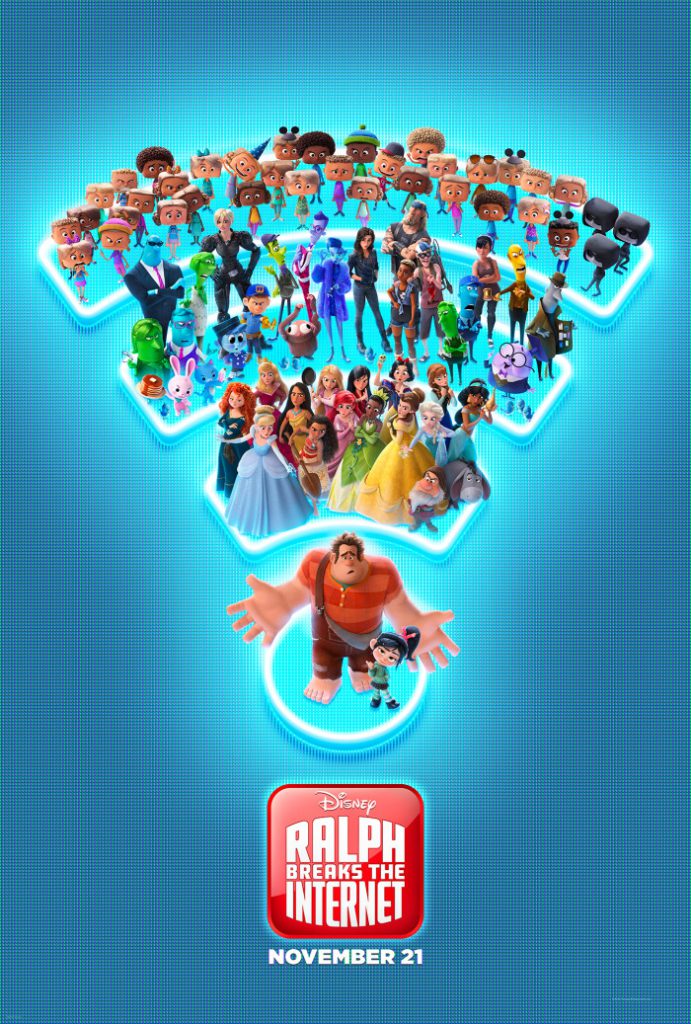
MOVIE REVIEW: Ralph Breaks the Internet

written by David Steffen

Ralph Breaks the Internet is a 2018 computer-animated children’s movie by Walt Disney Pictures, a sequel to the popular 2012 film Wreck-It Ralph. Six years have passed since the events of the first movie, and Wreck-It Ralph (John C. Reilly), the villain of the Fix-It Felix Jr. (Jack McBrayer) game, is still best friends with Vanellope Von Schweetz (Sarah Silverman), one of the player characters in Sugar Rush racing game. They work in different games in an arcade, and they meet to hang out every night when the arcade closes.

Vanellope has grown bored with her game; she knows all three tracks in her game by heart. Ralph tries to help her by making his own new track, but it all goes wrong and the steering wheel of the Sugar Rush game is broken by accident by a frustrated player. Ralph and Vanellope overhear the arcade owner Mr. Litwick (Ed O’Neill) talking with some teenagers who find a replacement wheel online for $200, but that’s more than the game makes in a year, so Mr. Litwick unplugs the game, and Vanillope and all of the others flee into the power strip, orphaned.

Meanwhile, Mr. Litwick has also added a Wi-Fi router, and Ralph and Vanellope set out into the wild unknown of the Internet to go find the wheel themselves, so they can buy it and save Vanellope’s game. With no idea how the Internet works, or anything about humanity besides what they can observe within the arcade.

Overall, this movie was fun, full of little Internet jokes, but it is nowhere near as good as the original Wreck-It-Ralph. Many of the jokes are tired, and unsubstantive, easy often-repeated jokes about spam and pop-ups, which aren’t particularly up-to-date. Almost all of the obstacles in the movie are self-made, and could’ve been avoided by just making better choices. That’s not to say that there aren’t some truly shining moments: the Disney Princesses are a particular highlight, voiced by their original Disney movie actresses!, and Shank (Gal Godot) the best racer in the Slaughter House racing game.

SPOILER SECTION

I usually don’t have a spoiler section in reviews, but there was a part of this movie that I wanted to talk about that is too far into the plot to be part of a spoiler-free review.

As Ralph and Vanellope find ways to make money to buy the steering wheel, Vanellope falls in love with the Slaughter Race game, and Ralph overhears her saying that it feels like home. Ralph is so jealous about this that he goes to dark web and buys a computer virus to let loose into the Slaughter Race game with the intent that it will slow down enough that she won’t want to stay there anymore. Predictably, this goes horribly wrong and becomes the major source of conflict for the movie. They end up working it all out and they stay friends at the end.

And I know this is a children’s movie, and forgiveness is often a big theme of children’s movies. But I think we also have to consider how kids can absorb the themes in such movies, and I think that there are some things that you can’t expect someone else to just get over. Ralph sets loose a harmful contagion because he’s jealous that his friend might take a job far away from him. The contagion gets loose and wreaks havoc. Sure, he asked questions about whether it’s really harmful or not, but he was asking them of someone selling viruses on the dark web.

DP FICTION #49A: “Heaven For Everyone” by Aimee Ogden

The summer that God came to Whartonville, I ended up trapped on the drugstore roof with only half a peanut butter sandwich and a seraph to keep me company.

The sandwich part is true! Hell, all of it is true. I’d eaten the rest of my lunch on the bus, before God’s approach hit the news. I can always buy more lunch in the hospital cafeteria. When the cafeteria and the rest of the city aren’t under three feet of water, at least. I know it was bad, and people died, but I’m still glad we got a flood instead of the plague of locusts that just hit Fargo. Two months later and you still can’t step outside without a crunch, is what I hear.

Anyway the seraph must have flown up before the rain really started coming down, and I managed to climb up onto the street light and from there to the roof. So there we were together in the middle of the storm. “I thought He didn’t do this shit anymore,” I said to the seraph. They shrugged, or at least I thought they did. It’s hard to read body language on someone who’s seven feet tall with six wings and a dozen mouths, but I’ve had practice lately. You know they can’t really speak for themselves? Sure, they talk, but everything they say is an echo from the Almighty’s own lips. Or at bare minimum from one or another of His prophets. So body language turns out to be kind of important. “There was a covenant or whatever.”

I pushed away from the ledge. I still had my umbrella at that point, I think, though with the way the rain was blowing I probably wasn’t any dryer for it. You’ve seen pictures of the flooding? They don’t do the wind justice. “I guess you probably can’t just fly us up and out of here, either.” The seraph’s burning wings were too drenched to do more than smolder. They shook their head, and a hospital ID card rattled around their neck. I knew we had a few angels working in the morgue. They liked to stay out of sight, and everyone else liked it that way too.

“Damn,” I said, because I didn’t have anything else to say. When we said we wanted heaven for everyone, you know, this wasn’t what we had in mind. We unlocked the doors and flung them wide open, but heaven didn’t let us in. Heaven came to us. “The storm’s getting worse.”

“YOU HAVE BEEN CAST DOWN, YOU THAT ONCE LAID LOW THE NATIONS,” said the seraph, and my teeth rattled in my skull. That voice had been created to level mountains and humble the mighty. I wasn’t that mighty and it didn’t make me feel humble, just headachey. I told the seraph not to rub it in and that I was pretty well aware by that point just how low I’d been cast, and they looked down at their bare leathery feet. And then I wasn’t so sure just who they’d meant.

That was when I heard the screaming. A little break in the wind, maybe. No, don’t call it the eye of the storm. What was at the center of that squall had a lot more than just one eye. But I’ll get to that. Just sit tight.

The screaming was a woman down on the street. Well, not on the street itself. The street was a riverbed by then. She’d grabbed a door somewhere, one of those interior jobs with the cork core to make it float. Might’ve been okay on a lazy river or something, but a trip down Almond Street meant real whitewater rafting.

The seraph leaned down next to me to get a view of her. They shook their head, and the long silver chains of their hair scraped against their guttering wings. “THOU SHALT NOT KILL.”

“You’re the angel,” I told them. “Do something.” But I don’t need to tell you how that rankled. I didn’t go to medical school for a million years because I like just standing around and watching people die. Did you know that most of the hospital staff were Paradisists? I don’t know the exact numbers, but upwards of eighty percent for sure. You see that many people die, you see that many people live badly, you’re going to want change. Well, we got it. First, do no harm, we said, but it turns out you can’t crack your way into heaven without screwing things up something serious.

Where was I? Oh, the woman. So the current was sweeping her down the street right in front of the drugstore and I thought, you know what? I’m already wet. So I grabbed the downspout and slid down and probably would have about broken both my ankles if there hadn’t been three feet of water to slow my fall. I’m tall but three feet of water is tall too, and it knocked me right over, and my first thought was, well, this lady and I are going to die together.

Then this huge splash, practically a tsunami, right next to me. The seraph took a cannonball right off the roof. Lucky they didn’t land on me or this story would be a lot shorter and also you’d have to hear it from my wandering soul. Assuming I’m heavenbound in the first place. That might be a big assumption for any Paradisist, I don’t know. They came down between me and the lady on the door and I was glad for that, I was halfway to the suburbs by then but at least I didn’t take the plunge for nothing, I got off the roof to save her and if my swan dive didn’t accomplish anything besides getting that seraph in gear, that’s okay.

I was underwater more than I was above, but I saw them grab her. They put her up on their shoulders like a kid riding piggyback. And then the last thing I saw before I went under again was them spreading their wings wide. And when I say wide—have you ever seen a seraph in flight? Their wingspan half filled the street. Diverted some of the water around the corner, onto Pierson Avenue—my apartment’s down that way, but that was the last thing on my mind at the moment, let me tell you. Not enough to stop the water, but enough to slow it down. I got my feet under me again, and I got to the seraph. “Now what?” I asked, because it was still raining too hard for their wings to light up. Not that a takeoff in gale winds probably would have been a great idea.

Well, that seraph picked me up like a rag doll and set me on top of the roof across the street, just a single story, and lifted the woman up right next to me. Then they started climbing up too, but lord, were they heavy. They tried stepping on the windowsill and ripped it clean out of the façade. We tried to heave them up, the two of us together, but like I said: heavy. And just then, guess who decided to come cruising around the corner? Yes, the Almighty Himself, a thousand blazing eyes and a hundred tongues professing His very own glory. You could see the rain sloughing off Him, rivers of the stuff. Literal rivers. I didn’t know then that January Lake had already burst its banks. That’s what happens when a man-made lake meets a heaven-made catastrophe. But still: could’ve been a plague of locusts.

After all of it, there’s still a part of me that wants to take a swing at the big guy. A stupid caveman gut reaction. You can’t punch a cloud, even one chock full of eyeballs. But you can want to punch it, and boy do I.

Anyway Almond Street had become Almond River at that point, really, and all we had was to hang on to the seraph like their life depended on it. Maybe it did. We hung on, together, just the three of us alone in the world for all we knew. That seraph held on so tight they broke my wrist, can you believe that? Still hurts when a storm’s coming. But we held on. That was all that mattered just then. And eventually the storm died down, and the river dried up, and the seraph lifted us down from the roof like the infants we were.

The woman looked around. “It’s still raining,” she said. “I thought it would have stopped by now. I mean—He’s gone, isn’t He?”

But I ignored her. Not at my best form just then. “It’s not fair,” I said, which was a damned stupid thing to say, because fair was never the point, was it? The idea of heaven for everyone wasn’t fair, it was just right. It was just … just.

The seraph spat a giant loogie onto the wet street. “RENDER UNTO CAESAR,” they said, and jerked a pair of wings in the general direction of where God had gone.

“You’re mad at the big man?” My wrist hurt like hell, but I remember the thing that bothered me most was that my shoes each weighed about a thousand pounds. Never occurred to me to just kick them off. “We’re the ones who pulled you down here into the mucky-muck.”

“We” was more literal than the seraph might guess. Or maybe they did know? It’s not like I’ve ever made a big secret of it. Doctors are supposed to help people, aren’t they? But they weren’t looking at me. Their stare drifted along the street, where the marble façade had come off the old theater and the windows had blown out of Martinelli’s. There were a dozen bodies left behind where the river had been.

I wondered then, what it was like in heaven before we brought the walls down. Which way the anger blew when He’d promised He wouldn’t turn it earthward again. Well, we wanted heaven for everyone. Maybe we just weren’t clear enough on the details of what heaven was supposed to look like, or who exactly counted as everyone.

The storm had passed, but there was still wreckage to clean up. Some of it human. “We’ll make things right,” I said. As right as they can be, after all this. “We’ve done harder work than this,” I said.

The seraph raised one wing. Sheets of rain slashed off the edges of their brass feathers, but I ducked underneath, and the woman—Karen, did I say that yet? Her name was Karen—anyway, she did too. They closed their wings around us and we huddled together until the last of the Almighty’s wrath had passed. Shared that PB&J, too, even if it was a little soggy, and before the rescue teams came through I gave the seraph my number in case they wanted to check out my lab. Maybe get out of morgue work. As for the Almighty, I think He headed north out of Whartonville, but I forget if that’s the summer He hit Winnipeg or Regina.


© 2018 by Aimee Ogden

Aimee Ogden is a former software tester and science teacher; now, she writes stories about sad astronauts and angry princesses. If she went to Hogwarts, she would be a Ravenclaw, and her patronus would be She-Hulk punching a nazi in the face. Her work has also appeared in Shimmer, Apex, and Analog.


If you enjoyed the story you might also want to visit our Support Page, read Aimee’s previous story “When One Door Shuts”, or read the other story offerings.

DP FICTION #48B: “How Rigel Gained a Rabbi (Briefly)” by Benjamin Blattberg

Rabbi Dov Applebaum argued—quite eloquently, he thought—for keeping the spaceship to its original flight plan. After all, there were Jewish children on Orion Station who needed Torah lessons before their upcoming B’nai Mitzvah. And yet the AI refused to listen to him and instead plotted a new course towards the distress signal on Rigel-7.

When the AI stated that intergalactic law compelled them to answer a distress call, Dov might’ve kept quiet—he wouldn’t actually have kept quiet, but he might have—but when the fakakta computer started citing Jewish law, Dov had to object.

“True, Leviticus says not to ‘stand idly by the blood of thy neighbor,'” said Dov, “but there are many interpretations of the Jewish law around distress signals. For one, what is a neighbor, galactically speaking?”

Dov could have discussed this for days, turning the argument about so that every angle of interpretation caught the light. But he only had hours before landfall and the AI had stopped actually listening anyway. Dov was used to that. His students throughout the galaxy didn’t listen, so why should his ship? Dov tried to imagine the Jewish children on Orion Station wailing and rending their garments over the delayed arrival of their favorite rabbi, but it was easier to imagine them eating synth-pork and forgetting what it meant to be Jews.

To add to Rabbi Dov’s woes, as his ship entered orbit and prepared to descend to the surface of Rigel-7, the Rigelian ambassador Cho’sun called on the viewscreen to forbid Dov from landing.

The spider-like Rigelian spoke its own language, which sounded to Dov like Coney Island being picked up with little warning and shaken. Luckily, Dov had a universal translator, a small black box clipped onto the upper sleeve of his flight suit, loaded with an AI that had been trained specifically to Dov’s native language. The box seemed to hum and clear its throat before translating.

“Listen, schmuck,” said the Rigelian through the translation box, “we have no laws to protect outsiders and you’ll just have to live with the consequences.”

Dov glanced at the translation box skeptically and tapped at it with one chewed nail. He couldn’t hear any loose parts in there—and if there were, what could he do about it?

“You hear me, schmuck?” Cho’sun waved its anterior arms in emphasis.

“Ah,” said Dov, as he attempted to stroke his red-brown beard thoughtfully, as his teachers had done and their teachers before them. The effect was rather ruined by his beard’s tendency to float up in microgravity, the curly mass haloing his jaw. “But you see, Ambassador, I am not landing—the ship is.”

Cho’sun made a sound like a garbage disposal chewing up dinosaur bones. The universal translator rendered this as laughter at first and then clarified: “Dismissive laughter.”

“Ambassador,” said Dov, “intergalactic law demands that distress signals be answered by the nearest available ship.” Even if that ship was a weaponless family transport that currently held no family, just Dov and his collection of Judaica, including a parchment Torah in a chased silver case all the way from Earth. That treasure he rarely brought out: only for brief ceremonies and never while his people were noshing.

“Universal law, shmuniversal law.” The ambassador flexed its claws, which might have been body language for emphasis or negation or something else entirely. Dov had skipped taking xeno-linguistics in college and the translator had its limits. “And in any case, Mr. Bigshot, we plan to take care of our own distress call, thank you very much.”

“Ah, so there is nothing to be distressed about?” Dov looked over at the terminal where he imagined the AI to be, a slight air of triumph in his raised eyebrow.

“Nothing at all distressing,” agreed Cho’sun. “As soon as we find them, we will kill off the entire unclean species that is sending whatever call you are receiving.”

Dov grimaced like he’d tasted a bad piece of whitefish. “It sounds, Ambassador, like you are speaking of genocide.”

Insofar as a spider can smile, the ambassador did. “Aha, now you understand.”

Dov’s bad fish expression deepened and he sighed. He couldn’t see any way to avoid landing on Rigel-7. He raised his hands and shrugged, the ancestral Jewish gesture for “What can I do about this? Nothing.”

Even the ambassador, who had probably never met a Jew before, seemed to take Dov’s meaning. Its voice took on a husky edge: the Empire State Building being scraped the length of Long Island. “We will cleanse Rigel-7 of this degenerate species and if you interfere, your life will be forfeit, schmuck.” The viewscreen went dead, the communication cut.

After a long moment of sighing, Dov flipped on a tablet, calling up commentaries on mediation by the most esteemed rabbis, as well as accessing a brief summary of the Rigelians. Their description—violent, xenophobic—sounded to Dov much like his ancestors’ stories of growing up with the Italians in Yonkers. And hadn’t they made peace there before moving to Scarsdale and Florida?

Perhaps Dov could be the one to bring Rigel-7 into the intergalactic community. He’d rather keep to his schedule and be teaching Torah to ungrateful children on backwards space stations, true, but if he had to make peace between two warring tribes on Rigel-7 and go down in history, so be it.

Perhaps, with his help, no one would die.

***

They were all going to die.

Cho’sun had called these other aliens a “species,” but the ambassador had called Dov a “schmuck,” too, so what did he know? Truth be told, Dov felt less like a schmuck and more like a schlemiel: not the clumsy waiter spilling the soup, but the guy the waiter spills soup on. Only in this case, it was more like the universe itself was spilling soup on Dov.

To Dov, these aliens didn’t seem like a distinct species. For one thing, there just weren’t that many of them, maybe ten total, camped out here in the middle of the green-black jungle. The jungle itself smelled faintly of burnt sugar, like overspun cotton candy, and was lush and thorny. Dov had time to discover the thorns as he hiked a few miles from the only clearing where his ship could land, since this benighted planet hadn’t any spaceport or roads or Chinese food. It was unpleasant, even if the air was breathable and the only large predators here were the man-sized, spider-like Rigelians.

Like the ones standing in front of Dov, asking for help, and not really listening when he said he couldn’t give them any.

“No, I don’t have ray guns on my ship,” explained Dov again. “What should I have ray guns for?”

The aliens talked to each other in voices that sounded like the Long Island Expressway being rolled up and eaten like pastrami, in the same language that Cho’sun used. Not only did they speak the same language and look nearly identical to Cho’sun—the same dark compound eyes, chitinous exoskeletons, and abundant limbs—but they waved away Dov’s well-thought-out arguments with the same motions. Dov wasn’t sure what set these Rigelians apart or why he hadn’t become a dentist with a nice little practice on Mars.

“Given your similarities, why do the Rigelians hate you so?” asked Dov.

Yen’tah, a smaller and slightly reddish but just as horrifyingly chitinous and hairy spider-thing, bristled, rising on its posterior four legs. “I reject your question—we too are Rigelian! It’s divisive speech like that—”

The other Rigelians began to yell at Yen’tah, making even more noise than it did. Dov’s translation box parsed their commingled cries: “hush, sheket, enough already!” Yen’tah made a gesture that Dov assumed was rude among egg-laying, non-binary sentients, but it stopped speaking and a moment later the ones who had shouted Yen’tah down quieted to a low grumble.

“The Kin hate us Other-kin because they do not believe in change and we have changed,” said Buch’ker, who was larger than all the other Rigelians and spoke in a voice that sounded like a Ferris wheel making love to a container ship. Buch’ker cocked its head to one side and then the other, a gesture that indicated thought among the Rigelians. Buch’ker was considering how to explain to Dov, and eventually it said, “We see the world differently.”

“Ah, a philosophical difference,” said Dov. “As a Jew, I have some experience—”

The Otherkin around him cut him off, their bulbous abdomens grumbling. The whole noisy rabble reminded Dov unexpectedly of a congregation held too long at service, with the promised land of cookies and gossip so close.

Buch’ker pointed to one of its eyes, as shiny as new challah, and said slowly, as if to a young child, “We see the world differently.”

After some clarification, with Buch’ker talking ever slower, Dov eventually realized this talk of “seeing the world differently” was the literal truth, as well as a metaphor. As metaphor: whereas the Kin avoided change and only maintained the technology they had inherited, the Otherkin believed change was acceptable, particularly when it would help them avoid extinction. And as literal truth: the Otherkin had experienced a genetic shift that allowed them to sense many different wavelengths. Though as they hadn’t developed a theory of genetics yet, Buch’ker explained this as simply a difference between its family—all the spider-aliens here being closely related—and the other Rigelians.

Also, Yen’tah explained, their thoraxes were smaller or hairier or something, but Dov couldn’t see it.

While Buch’ker explained this, two of the Otherkin scuttled up the trees and began to dismantle their nests high in the canopy overhead. These nests were temporary structures, Buch’ker had said before, put up and taken down as the Otherkin migrated through the jungle, staying ahead of their distant cousins and would-be murderers. A few others began to look up at their nests, realizing that Dov couldn’t help them, that running away would be their only hope. Maybe, if they were lucky, the next starship they called with their distress beacon would be more help.

And if not, more running, more distress calls, and more running.

The original distress beacon was still beeping—Dov’s ship relayed the call to his suit, despite his request to the AI to not do that, please. Dov had even asked the Otherkin to turn off the beacon, fearing that the Kin could track it.

Alas, explained the Otherkin named Gon’nef whose eyes were oddly close together, they had just recently invented the distress beacon and had not yet invented the off switch. A few Otherkin made a noise that seemed like laughter at that.

But Dov decided to leave that topic alone, especially after Buck’ker told him that the Kin had viewscreen technology that operated only on that frequency, but not a lot of other communication technology. The Kin couldn’t track this new signal since they didn’t invent any new technology, just lived with whatever old things they had and never changed.

“This taboo against change, this is taught to the Kin from your Creator or Creators?” asked Dov then, looking forward to discussing comparative religion rather than the first topic the Otherkin had wanted to discuss: ray guns.

“What kind of a cockamamie question is that?” grumbled Yen’tah.

“No,” said Buch’ker, “the Creators didn’t teach anything to the Kin before the Kin ate them.”

But now, with the Otherkin packing their nests and preparing to run, Dov felt rather sympathetic to that distress beacon, calling off into the interstellar night for help that might never come. There was something deeply Jewish about it. Dov could almost imagine the Otherkin as the Israelites of the book of Exodus, under the cruel yoke of the pharaoh.

“I have a plan,” said Dov proudly. “We run.”

“This he calls a plan?” Yen’tah sneered.

“If we run, we can escape,” said Dov, “as long the Kin can’t track our signal.”

***

“We easily tracked your signal,” said Ambassador Cho’sun, as it entered Dov’s prison cell, high up in an ancient tower. “But then you probably figured that out when we caught you.”

Dov turned from the window, where he’d been watching his spaceship’s rocket trail, but after he saw the look on Cho’sun’s face, Dov almost turned back. On a human, Cho’sun’s expression would’ve been called a deep frown, but on a human that expression wouldn’t have exposed so many chitin-brown, needle-sharp teeth.

Dov pulled at his flight suit to try to smooth it out and got his beard caught in the suit’s velcro at the neck. “Ambassador, intergalactic law demands that I be allowed to communicate with my home government.”

Cho’sun ignored him. It placed a black box between them and settled itself into the narrow room as best as it could. To fit here, Cho’sun had to fold and tuck its legs under it, like a spider who had extensively practiced yoga. Like most of the city that Dov had seen—while being carried by angry Rigelians—this room was built to a different scale and shape than these natives. The Kin literally lived in houses made for others who had come before them, which, even for Dov, was taking respect for tradition a little too far.

Cho’sun tapped the black box, paused, then tapped it again, this time harder.

“Ambassador, I demand—”

Cho’sun picked the black box up and held it up to its ear canal and shook it, before placing it down and pressing it one more time, firmly. Dov heard a slight pop, like a jar of garlic pickles being opened. Cho’sun clicked its mandibles, which Dov had learned was the Rigelian way of nodding to oneself. Then it began to talk.

“You putz, I told you not to land and what did you do?” Cho’sun fell silent, staring at Dov.

After far too long a silence, the Rigelian added, “That’s not rhetorical, mister. This is your trial right here, nu? You want we should execute you now? Don’t say anything, fine with me.”

Dov paused stroking his beard, getting it caught in velcro again. Buch’ker had told him the Kin would hold a trial before executing and eating him—more respect for tradition, Dov supposed. He just hadn’t thought his impending death would be quite so impending. Dov considered his situation against the long history of the Jews: this was not the worst situation his people had been in. It was not a very comforting thought.

“You want me to explain what I did?” asked Dov.

“Blockhead! We know what you did—you had the gall to save those unclean things with your…” Words failing it, Cho’sun waved a claw towards the window, towards the rocket trail, a column of smoke in the daytime sky. “They all escaped, so I hope you’re happy with yourself.”

Dov considered for a moment before deciding, yes, he was a little happy with himself. It hadn’t been, all things considered, a bad plan for him to run while broadcasting a signal the Kin could detect on the viewscreen technology, while the Otherkin made their way to Dov’s ship, following a signal only they could detect. Dov had a deep, rabbinical urge for symbolism, which was satisfied by the fact that the signal the Otherkin followed was their own distress beacon, relayed from his ship.

Only now he realized the plan’s tragic flaw: he was going to die. It had seemed so clear—and so righteous—at the time for Dov to be the decoy: if any of the Otherkin were left behind, they’d be immediately killed and eaten. At least Dov got this farce of a trial. Not a long enough trial for people to come rescue him, but at least it was something, right?

“We know what you’re guilty of,” said Cho’sun, “we just want to know why. You can explain yourself. And then, the execution.”

“But what am I really guilty of?” asked Dov, a sudden flash of inspiration rising to the surface of his brain like a matzah ball of the perfect lightness and airiness. “The Rigelians wanted to cleanse Rigel-7 of the Otherkin”—Cho’sun bristled at that word, the tiny hairs covering its body vibrating with anger, no xeno-linguistics degree necessary to read that—”and I have done that. There are no more of… them on Rigel-7.”

“Our world is cleansed,” said Cho’sun flatly, “but we were looking forward to killing them all. And now we have to be satisfied with killing only you. And speaking of that,” and Cho’sun reached out to turn off the black box.

“Wait, I can explain better,” said Dov, half-reaching out to swat away Cho’sun’s claw. He caught himself and steepled his fingers as if in thought. “We Jews have an old saying from the Babylonian Talmud—a book of commentary on our laws—that says, ‘whoever saves a life, it is considered as if he saved an entire world.'”

“I do not understand,” said the Rigelian, claw still hovering over the black box.

“Ah,” said Dov, nodding, “you see, it’s a moral calculation that asks us to consider—”

Cho’sun waved him off. “Schmuck, it’s ‘book’ I don’t understand. Whatever those are, we don’t have them and don’t want them.”

But then Cho’sun cocked its head to one side and then the other, the Rigelian gesture for considering.

“And how is one life equal to a world?” asked Cho’sun.

“A lesson like that has to be interpreted,” Dov said quickly. He paused as he heard steps coming up the narrow stairs to his tower cell. The steps were halting and clumsy, the narrow stairs not at all suited to the Rigelian’s sprawling legs. And on top of the click of Rigelian claws, Dov heard something else being dragged, bouncing on each hard step with a clunk. Dov had a moment of vivid worry, imagining them dragging some torture device up to his cell.

Cho’sun had to move aside for the other Rigelians to make their way into the cell and drop what they were carrying in a pile at Dov’s feet. The Jewish children of Orion Station would’ve said it was a torture device, but after wiping away some leaves and mud, Dov recognized it all as his collection of Judaica and teaching materials.

They were dented here and there and all jumbled together—the Seder plate next to the shofar horn, his tefillin straps tangled around Elijah’s and Miriam’s cups, the menorah with one arm bent down, the Torah surfing on a sea of yarmulkes, and a classroom’s worth of tablets, loaded with lessons on everything from basic Hebrew to the most abstruse rabbinical commentary.

“We have only you and all of this,” said Cho’sun, gesturing to the pile. And then, with a little more hope in its voice, it added, “Is any of this edible?”

“No,” Dov admitted, “but I can explain how a life is worth a world.” He picked up a tablet, the least dented and mud-covered, checking that it was still working. He turned it on, flipped to the first page, and turned it to face Cho’sun. “This, here, is the letter aleph, the first letter of the Hebrew alphabet.”

Cho’sun looked skeptically at the image of the aleph on the tablet’s screen. “Listen, bubele, no more nonsense—this you call the answer to my question?”

Dov considered that for a moment, before answering. “It’s the beginning of an answer.”

“How long will this answer take?”

For once, Dov didn’t say what he thought—hopefully long enough for a ship to come rescue me—but merely shrugged, hands up, and gave Cho’sun the same answer his rabbis had given Dov back when he was a student. “It takes as long as it takes.”

Cho’sun looked back at the tablet, its head cocked first to one side, then the other. “Oy vey,” it said finally, and then clicked its mandibles. “What comes next?”


© 2018 by Benjamin Blattberg


Author’s Note: The seed of this story was probably planted by William Tenn’s “On Venus, Have We Got A Rabbi!” Not the story—just the title. (Though eventually I did read the story and you might want to check it out, too.)


Ben Blattberg is a software developer, improviser, and writer currently living in Austin, TX, as long as there are no follow­up questions on any of those facts. His stories have appeared in Tina Connolly’s Toasted Cake, Crossed Genres, Pornokitsch, Podcastle, and Pseudopod.


If you enjoyed the story you might also want to visit our Support Page, or read the other story offerings.

DP FICTION #48A: “Local Senior Celebrates Milestone” by Matthew Claxton

The reporter is young, smells young even through the miasma of bleach and boiled vegetables. Three Willows Retirement Village is not an olfactory feast, so Millie is grateful for the scents of mango shampoo and coconut hand cream the girl brings with her.

“First of all, congratulations on the milestone!”

Millie wraps her knuckles around the gnarled head of her driftwood cane, leans forward.

“Congratulations?” She releases a calculated chuckle, gently chiding. “On not dying?”

“I just mean… I mean, not everyone gets to celebrate their one-hundred and tenth birthday!”

“Well, that’s very true. I’ve been blessed.”

“I was hoping you could tell me a little about your life. You must have seen so much!”

“Oh, yes.”

The girl has a notebook out now, pen poised.

“I was hoping you could tell me, what’s your earliest memory?”

The pods. The heat of the sun soaked into the sand by day, warming the cluster of egg-sacs. Warm, dark, protected. Her lungs and gills growing, the bones of her limbs hardening. Keratinous spurs on her wrists grew sharp, and the urge to surface gripped her hard. The skin of the egg parted like paper, and salty sand mingled with the cooling jelly. She had squirmed onto the beach. Her parents watched nearby, their horses shying.

Her siblings had crawled free, but she had been the first, the first to see the stars.

“I remember the beach. We always lived near the water, and I loved to run across the sand at low tide, when it was cool. When I was older we’d ride the old mare down. Tried to get her to gallop along the shore once, and she threw me right into a tidepool!” Millie forces a chuckle and a wry smile.

“You grew up on a farm?”

“Oh yes. Lots of chores to do. And schooling, of course. Mama educated us herself, us being so far out in the country.”

They stalked one another through the trees and fields, games of hunt and evasion. Millie had the sharpest nose. She could find her siblings hidden even when their skin changed to match the mottled pattern of leaf and twig. They pounced and bit one another, drawing blood and laughing, violently tender.

Later, Mother drilled them. Human languages first, English and Mandarin, German and Spanish. “You must be able to blend among them. You can’t rely on your hybrid DNA. Never let them suspect. The slightest slip could be fatal to our kind and our mission.”

After lunch it was their Home language, the keening and clicks, the consonants aspirated through flared gills. They studied the old poets and the old songs, in glyphs as twisted as the coils of barbed wire that marked the edges of their homestead.

The reporter leans forward, elbows on the table. “I suppose you didn’t have a telephone, or a car? Do you remember when the first time you saw a car was? Or a radio?”

Father held the communicator in his palm. Smooth as beach glass, liquid fractals pulsed from its center as he clicked and cooed.

“When will I be able to speak to Home?” Millie asked. 

“When the time is right,” said Father. “When you are old enough to begin work on the mission.”

He gently stroked her hair, palm still warm from the communicator. “Soon,” he promised.

“Radio seemed like magic. I heard it first at another family’s home. Voices through the air, you know. The first car I ever saw was considerably less pleasant — it was an old Model-T. The rattle and roar of the thing! I clapped my hands over my ears.”

The reporter nods, scribbling.

“You’ve lived through such turbulent times. What was it like to live during the World Wars?”

The government man’s heels beat hard against the cheap rooming house carpet. Millie held tight to the wooden handles of the garrote, ignoring the blood that seeped around the wire and dripped onto her good shoes. 

Too close. He’d come too close, had seen her emerge from the lake near the munitions factory.

When his heart stilled, she eased him to the floor, then collected every trace of her presence from the small room. She’d have to abandon her identity, find another source for the chemicals they needed for the third phase. The damned war had made the humans watchful, almost clever.

Not so clever that they wouldn’t be easily thrown off the trail. She left a torn page from a German-American Bund pamphlet in the back of the cheap plywood dresser. 

She left, not worrying about fingerprints on the doorknob. She didn’t leave any.

“Nothing as exciting as you may imagine. It was all victory gardens and scrap drives for me. The war on the home front. I was just fortunate that I didn’t have any children in harm’s way.”

“But you did have children?”

“Oh my, yes. Everyone had a big family, back then. A family meant a future.”

She and Henry didn’t bother to put their clothes back on, just walked out of the beach house and onto the moon-silvered sand. She dug the hole with a garden trowel.

“I’m worried,” he said. “We’ve lost contact with the Chicago brood.”

She dropped to her haunches. “Protocol. Scatter and hide. They’ve done it before, after a mission’s gone bad.”

“It’s been too long. I think they’ve been captured, or killed. One of those G-men pursuit teams maybe.”

She shuddered, half at his words and half at the birth-ecstasy. The egg mass slid out of her and filled the hole. Blue-veined embryos blinked at the black sky for a moment before she covered them with sand. She pressed one hand to the spot for a moment, felt their warmth.

“It will be okay,” she said.

“Tell me about your husband.”

“Henry? We met at work, after I first moved to the city. I knew he was a good man, and, well, our families were friendly. We were a good fit.

“It turned out to be a real love match, though. That was rarer than the movies would have you believe.”

She pauses, contains herself. Let the reporter see the sorrow, not the anger.

“He died young.”

The first bullet caught him in the lower back. Purplish blood oozed from the wound as they ran through the alleys, seeking cover in the steam rising from the sewer grates. Men in long coats ran behind them, yelling into crude radios.

The second bullet struck higher, in Henry’s spine. His legs spasmed wildly as he fell. She grabbed his coat, pulled him with fierce strength, but the alley ended in a filthy courtyard.

“Go,” he hissed. She hesitated, and he sang the word in the speech of Home, his golden tones strained with pain. She scaled a fire escape, bullets shattering against the metal railings.

She looked back once. He wasn’t moving.

That winter, she found the leader of the FBI pursuit group. She watched his house burn on a cold night. No one got out, not the government man, not his wife, not their children.

“I still miss him. He was a good man. Left me with a little nest egg, fortunately. In my later years, I travelled, all the trips we’d meant to take together after we retired. But the loneliness… it can get to you, sometimes.”

Goa was comfortably warm, the monsoon kind to her skin. The mathematician at the university had proved amenable to sharing his notes. He was bright, too bright. She cupped the communicator in her hand and reached out to the brood in Bombay. They would need to arrange an accident.

After, she reset to commune with Home, but the device remained silent and dark.

Nothing. Three years, and no word.

What was going on?

The stars were cloaked by clouds, and the sky held no answers.

The reporter taps pen to notebook. She is already running low on questions. Millie sighs. She’s been through the gauntlet at one-hundred, and again at one-hundred and five. There are only a few questions left to go, then it will be time for the tooth-achingly sweet cake, and a walk back to her room.

“Did you ever expect you would live so long?” The question bursts forth, the pleading look says the girl would take it back if she could.

“No,” Millie says. “But when you’re young, you always think you’ll live forever.”

Millie’s knee ached, the arthritis a gift of her human genes. A hurricane was coming, rolling in across the Gulf and making for Florida. She could feel it even inside the sterile grey-carpeted halls of Cape Canaveral.

She pushed the mail trolley, dropping packages in cubicles and offices. When no one was looking, she palmed the scanner the Moscow brood had sent her over racked floppy disks. The scanner hummed in her hand like a wasp as it soaked up data.

They were stealing technology from the humans now, desperately trying to build an alternate means of communicating with Home. Pathetic, but what else could they do?

They could forget. Susan and Abel and Henry Junior spoke to her in English now, called her on Sundays and worried about mortgages as much as missions.

How many of the old poems did they still remember? How much could they be expected to remember, three generations removed from Home?

Thirty years, and no word.

“I suppose everyone learns the secret, if you go on long enough,” Millie says. “You just keep on living. You hope you find someone you can love to spend your life with, you try to do right by your children. You do your work, and hope things turn out well. They don’t, always. You have to make your peace with that. That’s about all I’ve learned, in my time on this planet.”

She sighs, and something in her face makes the reporter draw back a little. A little too much revealed there, the twinge of guilt at any crack in the facade. But she’s an old woman. Who will think her moods are anything worse than the product of a decaying mind?

The singing comes from the kitchen, singing and fire’s feral glow. The fools have somehow lit a full hundred and ten candles atop the white-and-blue frosted slab. It reminds her pleasantly of a burning house.

The chorus of “Happy Birthday” dies away.

“Blow out the candles, Millie!” shouts the home’s manager through lipstick-smeared teeth.

The reporter has her camera pressed to one eye. Fine, if they want a photo, she’ll give them one. She draws breath into lungs deeper than any human’s, and purses her lips.

The flames flicker and die, a hundred smoke trails coiling about like seaweed at slack tide.

The applause is genuine, the kitchen staff and nursing aids shouting in wonder. “Go Millie!” “Lookit that!”

The reporter leans in again, face bright. Good photo for her sad little page twelve human interest story, that’s all she cares about.

“What did you…” She breaks off. “Your brooch…”

Millie puts a hand to her sweater. The communicator hums with life. Fractals bloom across its surface in wondrous, glowing profusion. She clutches her hand around it hard, closes her eyes. It has been so long. One of the lost broods?

No.

Home, the signal strong and clear, the message simple: We are coming.

Millie smiles.

“Just a piece of costume jewelry, dear. What were you saying?”

“I, um, what did you wish for? When you blew out the candles?”

“If I tell you, it won’t come true now, will it? But I think you’ll find out soon enough.”

She lets them cut her an extra slice, and with relish she licks the frosting from her fingers.

On her way back to her room, she hums one of the hymns of home, in subsonics and whispered gill-speech too low for any human to hear.

Millie smiles. She is eager to clip out a copy of the young reporter’s story. Assuming there is another issue of the paper.

It would be nice to have a keepsake. It’s been a day for milestones.


© 2018 by Matthew Claxton


Matthew Claxton is a reporter living near Vancouver, British Columbia. His stories have appeared in Asimov’s Science Fiction, Mothership Zeta, and The Year’s Best Science Fiction 34. Rumours that he is three small dinosaurs standing on each other’s shoulders in a trenchcoat have never been proven. You can follow him on Twitter @ouranosaurus.


If you enjoyed the story you might also want to visit our Support Page, or read the other story offerings.

DP FICTION #47C: “The Dictionary For Dreamers” by Cislyn Smith

Apology

(n) A sincere, though ultimately futile, effort to make right a wrong. Always involves books.

Example:
This. She didn’t mean to. It was a mistake.


Arise

1. (v) To get up from a position of repose.
2. (v) To become evident or apparent.

Example:
Time to get up. You arise from the bed, drifting, almost floating, toes straining down to reach the ground, arms flailing a bit for balance, before you thump-settle back into place.

Shake your head. Yes, that was odd. Still, you’ve forgotten about it by the time you’re dressed. Just one of those things.


Belong

(v) To be in the right and proper place, to fit in.

Example:
This is your home. Obviously. You feel it in your feet, the way they settle on the floor when you get out of bed. Just so. You feel it in the air. You crack your neck and stretch and just know. That’s how it is.


Camouflage

(n) A disguise to help someone or something blend in, a way to pretend that you belong.

Example:
The landscape shifts constantly, adjusting. For you. It’s subtle — a tree moves here, a car is further down the street and a different color there, and the sky is the exact shade you like just when you need it to be. You don’t notice it, consciously. You’re not meant to, after all. The back of your mind sees it, though, notices the effort, and relaxes. Yes. This is right. This is home. This is where you are meant to be.

Mostly.

There is a tiny part of you that thinks maybe the curtains should stay the same color, even if you do regret them two weeks after putting them up. That sometimes wonders, if just for a second, why the spice jars never run out of your favorite things and marvels at just how nice the neighbors are.

It’s easy to ignore.


Close

1. (adv) Near
2. (adj) Dear
3. (v) To end

Example:
“I’m sorry, only close relatives are allowed after visiting hours.”


Content

1. (n) The material included or addressed in a book, a movie, or a dream.
2. (adj) In a state of simple peace.

Example:
You.


Current

1. (adj) In the present. Right now.
2. (n) That which pulls you along in a given direction.

Example:
On a quiet city street, a man walks just in front of a woman, feet crunching in tandem on sidewalk snow. Suddenly, she speaks, her voice very clear in the cold morning air.

“Last night I dreamed I got pulled out to sea, and then there was a storm. I was trying to stay above water, but the storm was doing strange things to the waves. They started turning to glass and ice all around me — planed crystalline pieces splashing and curling up and crashing near me. It was beautiful, honestly. I felt so guilty, though. I couldn’t tell the difference between the glass and the ice, and so many things I touched were broken or melted as I scrambled to keep my head above water. I felt like I was breaking everything beautiful around me.”

He can’t help himself. He turns to the stranger in the blue peacoat behind him, who’s just shared this private little moment, and says, “You were only trying to stay alive.”

But now she’s moving past him, headphones on, looking down at the phone in her hand. The conversation wasn’t with him. “No, I woke up first. Sure. Sure. See you later.”

This is happening now.


Dictionary

(n) a tool for discovering meaning.

Example:
The truth points to itself.


Dreamer

1. (n) One who experiences a dreaming state, usually while asleep, moving through a world of ideas.
2. (n) One who yearns or wishes for something not in evidence.

Example:
“So, what do you think happens to the people in a dream?”

“You mean in general, or… what?”

“Like, when the dreamer wakes up, right?”

“God, you’re in a philosophy class aren’t you? Friends don’t let friends sign up for philosophy courses.”

“I’m not, actually. And there’s nothing wrong with philosophy! I just… never mind. It’s stupid anyway.”

“Oh, don’t be like that! Hey, where are you going?”


Example

(n) An illustrative item.

Example:
White sheets, shadows stretched across them, and a prone form in the bed. There are monitors, beeping. Clear plastic tubing runs down from an IV stand, is taped to a bruised hand. Her closed eyes are not moving. She is lonely. She will be gone, soon. And then?


For

1. (preposition) Belonging to
2. (preposition) Because of
3. (preposition) Concerning, about
4. (preposition) In support of

Example:
Dictionary For Dreamers.


Forget

(v) To lose memory of something.

Example:
Evidently there was an accident. It was nothing to do with you. Should I send another book? I am inclined towards apologies.


Gentle

1. (adj) Kind, tender
2. (v) To pacify

Example:
You are holding a leaf, turning it gently by the stem in the autumnal sunlight, watching the way the colors shift across its surface. Red. Orange. Green. Brown. There’s a whole year in your hand. You run a fingertip along each of the veins, being careful of the brittle edges, and then you place it — just so — back on the leaf pile where you found it.

The ground ripples as you walk away.


Home

1. (n) Where the heart is.
2. (v) To return by instinct, back to the heart.

Example:
“Do you hear that?”

“Like someone crying, right? That is so weird.”

“Yeah. I thought I heard someone say ‘I just want to go home’ and then it started.”

“Did you leave the television on upstairs?”

“No, I’m sure I didn’t. I’ll go check, though. See if you can figure out where that’s coming from.”

“I can barely hear it now. What am I supposed to do, look under the couch and inside the fridge? There’d better not be anyone crying in there. Well now I can’t hear it at all. Hello? Are you coming back downstairs? Where’d you go?!”


Inspire

1. (v) To fill someone with an urge to create
2. (v) To breathe in

Example:
You are all my muse. Exhale.


Join

1. (v) To connect or link things together
2. (n) The seam or place where things come together

Example:
The handle of his favorite mug broke this morning when he grabbed it out of the kitchen cabinet. A handful of handle made him laugh a little, and now he sits at the kitchen table, superglue at hand, preparing to patch things up.

But first, he can’t help but touch the broken bit, exploring the gentle topography with his index finger. It reminds him of losing a tooth as a kid — it feels raw and exposed and he winces in sympathy, but still he probes the place which used to be whole, and now there’s a hole instead.

He’s surprised by the remnants of glue on the mug — how many times has this happened before? How could he not have noticed, or did he just forget? Surely it will be as good as new soon, though. Surely.


Kill

1. (v) To end life. To cause death.
2. (v) To put an end to a process.

Example: How soon is soon?


Lie

1. (v) To be in a horizontal state, resting.
2. (n) Untruth.

Example:
“Are you all right? You need to lie down or something?”

“No, I’m fine.”


Miss

1. (n) A polite form of address for a young woman.
2. (v) To fail to touch, to not make contact.
3. (v) To notice the absence of someone or something.

Example:
“Miss? Excuse me, miss? You can’t sleep here.”

And

“I can’t miss this connection.”

And

“Did you miss me?” (Yes. Yes. Yes.)


Nous

(n) The mind, moving, moving, moving

Example:
When you can’t sleep, and you’re staring at the ceiling in the dark, listening to all the little noises that seem so loud. You’re tired. You need to sleep. You know this. But you resist the temptation to check the time and roll over and try counting backwards, or maybe flexing your toes one at a time under the sheets, and feeling the thud of your heartbeat just so, interrupting your thoughts. Not that you’re thinking of anything. No. Just the sleep you need. Well, and maybe that thing you want to write, and now there’s a list of things half growing there in the space behind your eyes, disjoint and fragmented. If you manage to drift down into restlessness, the list will precipitate through your dreams, to-dos and phrases and fragments of numbered items settling in to the nonsense you think of as dreams, held together loosely by the tenuous threads of story your mind insists on imposing.

It’s OK. Let it go.


Open

1. (adj) Having the interior accessible
2. (v) To cause to be receptive

Example:
“I can’t get this damned jar open.”

“What’s in it, anyway?”

“I don’t know. Could be anything. Beets. Confetti. Time. The stuff you keep in jars, right?”

“The stuff you keep in jars maybe. Here, give it to me.”

“I really think we might have to break it. It’s so stuck.”


Precipitate

1. (n) A substance deposited from a solution.
2. (v) To cause something to happen.

Example:

She stands in a snowy field, trees stark inked lines on the horizon. She’s young, in a warm blue peacoat, too-big hat sliding down over her eyes. Her mittened hands turn upward to the sky, gathering snowflakes, and then she presses them together. A sheet of white paper shifts from between her fuzzy palms to the ground, compressed from the crystals falling from the sky, and she opens her hands to the heavens again. And again. And again. The pages accumulate around her legs, piling up, faint and shadowy words smearing the white as the light fades.

She finally turns to look at you, but you’re gone.


Quicken

1. (v) To give something life.
2. (v) To make something move faster.

Example:
Something is behind you, something dark and dangerous. You dare not look back. The hallway stretches ahead and behind, shadowy, the walls turning in ways that don’t quite make sense, as you run. Your steps quicken, and you can hear, far away, something rhythmic and mechanical. You move toward the sound.


Reality

(n) No. I’ve been defining reality for too long. Look up ‘gentle’ instead. That’s a nice one.


Start

1. (v) To begin, as one does, at the beginning.
2. (v) To jump a little, in surprise.
3. (n) The beginning, where one begins.

Example:
I’m sorry. I don’t remember now. It’s been so long, and I’m tired.


Turn

1. (n) Opportunity
2. (v) Change direction
3. (v) Change state

Example:
“Go on, sweetie, it’s your turn now.”

The woman pushes the child toward the swimming pool. She takes two stumbling steps forward, bare feet on hot concrete, and then stops. The water shimmers, like glass, like ice. The orange waterwings are too tight on her arms, and there are too many people, and her tummy hurts, and it smells like chemicals and other people’s ambition. She turns and runs away through the crowd, past the too-long legs of her mother, back into the cool echoing darkness of the locker room. She just wants to get away. She isn’t watching her footing, on the water-slick tiles by the hard wooden benches and sharp metal lockers.

The world holds its breath.


Underlie

(v) To be foundational, the cause of something.

Example:
It’s not a lie if it’s everywhere, if it’s underneath everything. Right? So why do I feel so guilty?


Visionary

(n) One who sees more, though they may understand less.

Example:
The ladybug crawls along the back of your hand, having been liberated from the windowscreen. You’re looking closely at its spots, and the closer you look, the more there seems to be to see. Finally, you look away, half laughing. It almost felt as if something were looking back at you, from that infinite fractal regression of spots on spots on spots. You put the little insect outside, on a leaf.


Wake

1. (v) to arise from sleep, to stop a dream.
2. (n) A funerary vigil

Example:
“I’m sorry, but she’s never going to wake up. There’s nothing we can do.”


Xenolith

(n) A rock fragment differing in composition and origin from the rock or crystal enclosing it.

Example:
How did things get so strange? There aren’t enough books to make this right.


You

(pronoun) The person being addressed.

Example:
You never saw her. You were nearby — physically or conceptually — and were drawn in. You think this is about you, but that doesn’t make you vain. It has been. Mostly. About all of you. Go on now. Turn the page.


© 2018 by Cislyn Smith


Author’s Note: I’ve always been a semi-lucid dreamer, exploring weird dream worlds half aware and with an overwhelming sense of responsibility for the things happening in the dream environments. I had a dream one night wherein I earnestly tried to apologize to everyone I met, but nobody ever quite understood what I was saying or why. I woke up thinking I needed a dictionary to apologize properly, sat on that idea for a few days, and wrote this story shortly after.


Cislyn Smith likes playing pretend, playing games, and playing with words.  She calls Madison, Wisconsin home where she enjoys the company of three cats, some humans, and an assortment of cool bacteria. She has been known to crochet tentacles, write stories and poems at odd hours, and gallivant. She is occasionally dismayed by the lack of secret passages in her house. Her poetry and fiction have appeared in The Best of Electric Velocipede, Strange horizons, Star*Line, Remixt Magazine, and Flash Fiction Online.


If you enjoyed the story you might also want to visit our Support Page, or read the other story offerings.